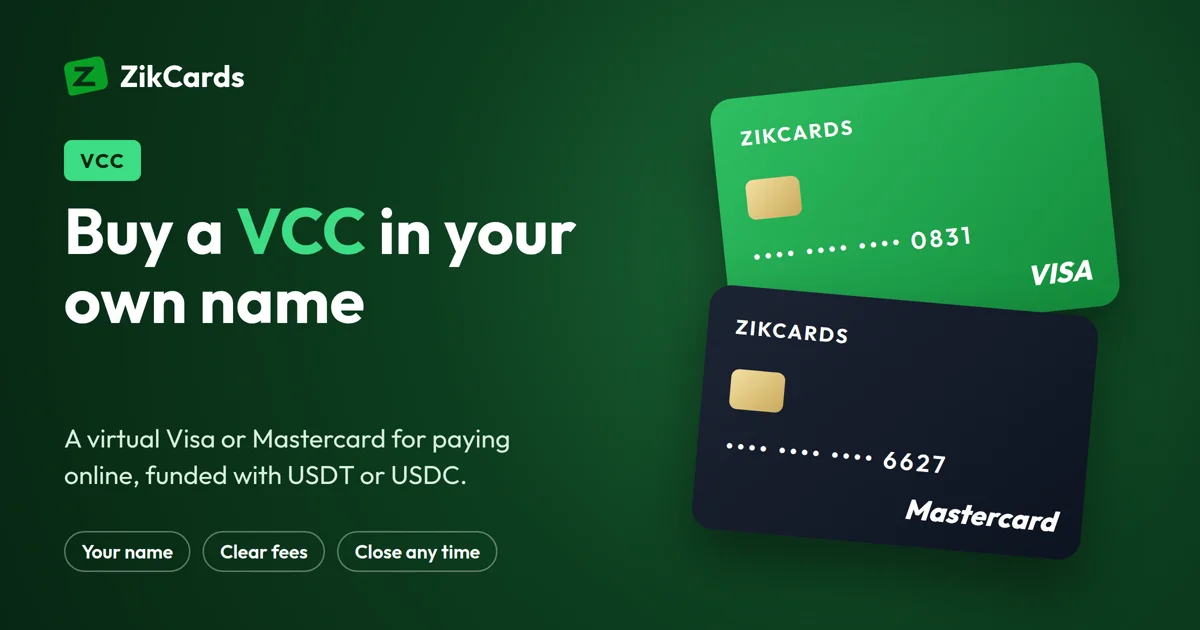
A VCC is a virtual credit card: a Visa or Mastercard that exists only as a card number, expiry date and security code, made for paying online. To buy a VCC safely, get it from a card provider that issues it in your own name after checking your ID, not from someone selling ready-made cards. Below: what a VCC is, the checks to make before you buy one, what it costs, and how to get one in about 5 minutes with USDT or USDC.
What is a VCC (virtual credit card)?
A VCC card, or virtual credit card, is a card number you use online instead of a plastic card. It has the same three details as any card (a 16-digit number, an expiry date and a 3-digit security code), and it works wherever its network, Visa or Mastercard, is accepted online.
The name "VCC" is used loosely. Banks use it for a spare number linked to a credit card you already hold. In Bangladesh, Pakistan, India and many other countries, people say "VCC" for any virtual Visa or Mastercard they can get online, often to pay a foreign website that refuses their local card. Many of these are not credit at all: you load money first and spend only that.
That is how a ZikCards card works. It sits on a US credit BIN, but it is loaded from your balance, with no credit line, no bill and no interest. Our guide to the virtual credit card explains the difference between credit, debit and balance-funded cards in more detail.
Where to buy a VCC: a VCC provider or a seller
You can get a VCC in two ways: open an account with a VCC provider that issues the card in your name, or buy a card that someone else has already made. Only the first is safe to rely on.
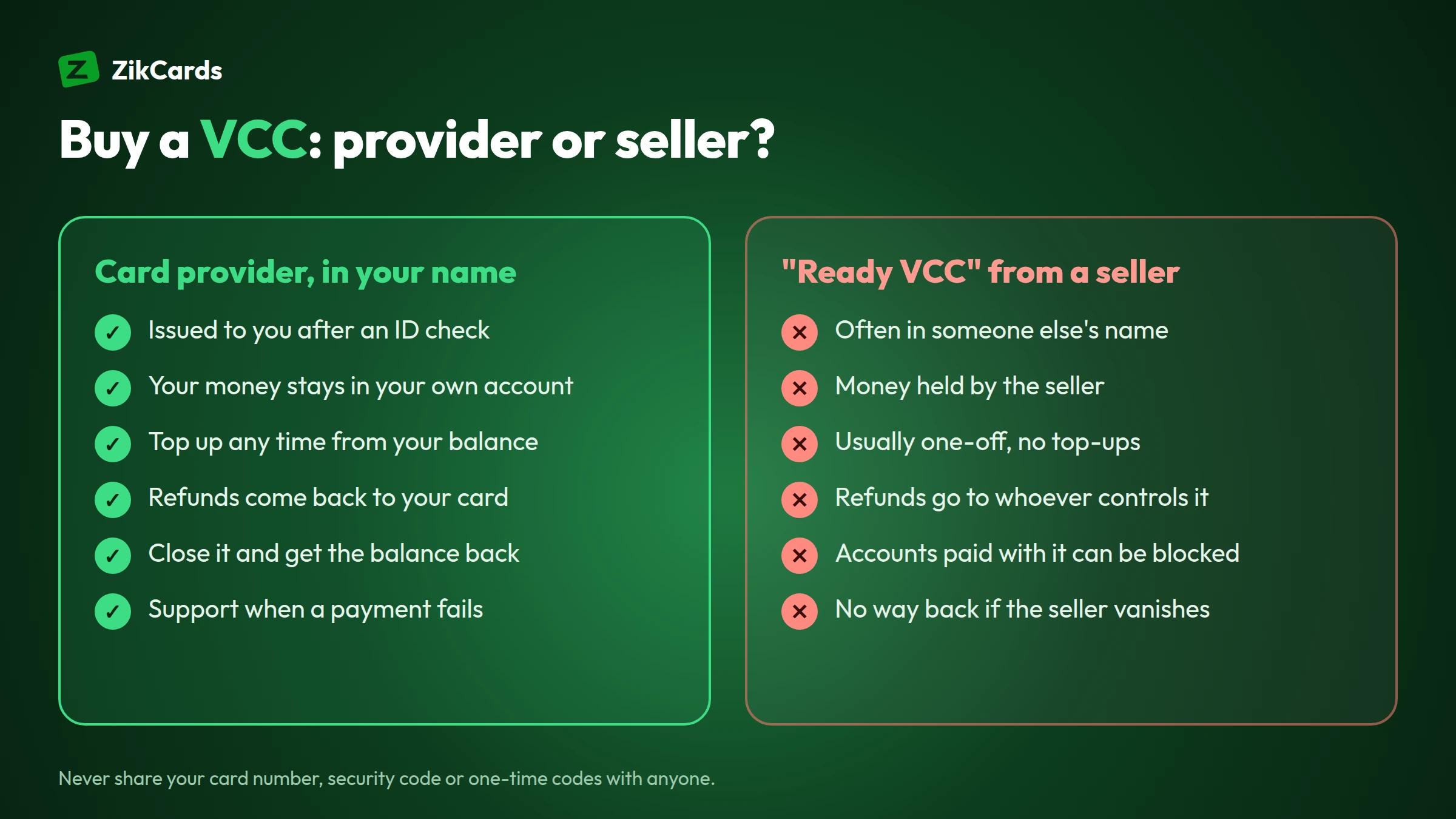
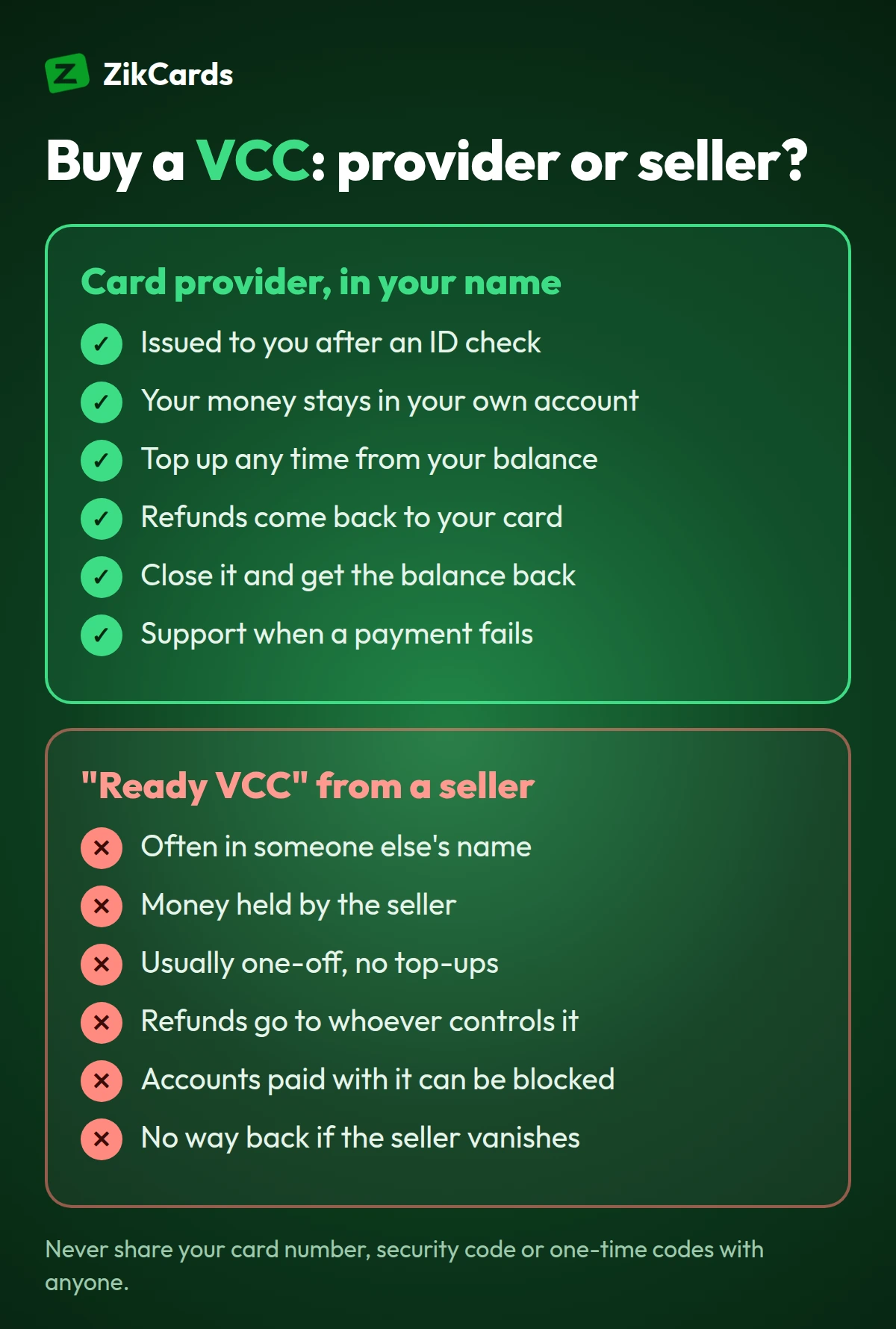
| Card provider (in your name) | "Ready VCC" from a seller | |
|---|---|---|
| Whose name is on the card | Yours, after an ID check | Often someone else's, or unknown |
| Your money on the card | In your own account; you can close the card and get it back | Held by the seller; gone if the seller disappears |
| Top-ups | Any time, from your balance | Usually one-off, or through the seller again |
| Refunds from shops | Come back to your card | Go to whoever controls the card |
| Help when a payment fails | The provider's support | Rarely any |
| Risk to your accounts | Low: the card matches you | High: platforms can block an account paid with a card in another name |
Be careful with offers that promise a card "without verification" or "verified accounts". A real card issuer has to know who its cardholders are, so a card with no ID check usually means the card belongs to someone else. Platforms such as PayPal, Google and Meta check that a card fits the account, and an account paid with someone else's card can be closed.
What to check before you buy a VCC
The best VCC for you is the one that passes seven checks. Before you pay for any VCC, check whose name it is in, who issues it, how you fund it, what it costs, its billing address, how it handles verification codes, and how you get your money back.
- Your own name. The card should be issued to you after an ID check. ZikCards asks for a photo ID and a short selfie once.
- Who issues it, and from which country. A card from the US or another country with good acceptance online avoids the most common reason local cards are refused abroad: the card's country.
- How you fund it. Check what you can pay with. ZikCards takes USDT or USDC, so you need no bank account. See how to buy a virtual card with crypto.
- Every fee. Creation, loading, deposits, declines, payments to foreign merchants and withdrawals. A low price on the card can hide high fees later.
- The billing address. Shops compare the address you type with the card's own. Use the billing address shown on the card page when the card has one.
- Verification codes. Some shops run a 3D Secure check that may ask for a one-time code. Cards with 3D Secure show it on our Issue card page; see our 3D Secure virtual card guide.
- Getting your money back. You should be able to close a card and get the balance back. On ZikCards, closing returns the balance to your wallet in full, with no fee.
How much does a VCC cost?
A ZikCards VCC costs $5 to create, once, with no monthly fee. Moving money from your balance onto a card costs 3%, plus $1 on later top-ups under $100, and $1 stays on each card while it is open, which you get back when you close it.
| Example: your first card, loaded with $50 | Amount |
|---|---|
| Card creation, one-time | $5.00 |
| Load onto the card | $50.00 |
| Card funding, 3% | $1.50 |
| You pay from your balance | $56.50 |
| You can spend on the card | $49.00 (the $50 less the $1 kept on it) |
Two more fees can apply. Adding money to your balance costs from $1 + 1%, depending on the network you send on, and the smallest deposit is $20. And a payment that settles outside the US carries the card issuer's cross-border fee, shown in each card's Fees before you create it. Some cards also charge when the same purchase is declined again and again. Every figure is on our pricing page.
How to get a VCC with ZikCards
To buy a virtual credit card from ZikCards, you need a phone, a photo ID and some USDT or USDC. Your first card takes about 5 minutes, from sign-up to a card number you can use.
- Create your account and verify once with a passport, national ID card or driving licence and a short selfie on your phone. Most checks are approved automatically within minutes.
- Add money with USDT or USDC. Send on the network you chose; a send on the wrong network is usually lost. New to stablecoins? See how to buy USDT and which network to send on.
- Open the Issue card page and choose a card. It lists every card on sale with its fees and features, and says which ones your country can use.
- Choose an amount and create the card. The card number, expiry date and security code appear on the card page, ready to copy.
You can choose a virtual Visa card or a virtual Mastercard each time you create a card. ZikCards serves the US and almost every other country; residents and nationals of a few countries cannot sign up, listed on our restricted countries page. To compare us with other providers, see the best virtual cards and what to compare.
VCC for PayPal, Google Ads, Facebook ads and Amazon
Most people buy a VCC to pay one particular site. ZikCards cards work with Google Ads, Facebook Ads, ChatGPT and Claude. Each platform still runs its own checks on your account, so no card provider can promise a payment will go through.
- VCC for PayPal. You can add the card to your own PayPal account, as you would any card, and PayPal may make a small charge to confirm it. See our guide to a virtual card for PayPal.
- VCC for Google Ads. Add it in your Google Ads billing settings. Our guide to a virtual card for Google Ads covers each step and the common payment errors.
- VCC for Facebook and Meta ads. Add it in Meta's billing settings. See our guide to a virtual card for Facebook ads.
- VCC for Amazon. Add it as a payment method in your Amazon account with the card's billing address. If Amazon refuses it, our guide on a card declined on Amazon explains each message.
Use your own accounts only. A card is for paying, never for getting round a platform's own rules on where it serves or who may open an account.
Mistakes to avoid with a VCC
Most VCC problems come from a few avoidable mistakes.
- Sharing your card. Never send your card number, security code or one-time codes to anyone, including someone offering to "verify" an account for you. ZikCards never asks for them.
- Retrying a declined payment. The same details get the same answer, and some cards charge for repeated declines. Find the reason first; see why a card is declined online.
- Loading too little. Load the price plus the $1 that stays on the card, plus any cross-border fee.
- Closing a card before a refund arrives. Refunds go back to the card that was charged, so keep it open until they land.
- Buying from chats. A seller on WhatsApp or Telegram cannot issue a card in your name, and you have no way back if they vanish. ZikCards never sells cards in chats or messages you first.
Frequently asked questions
What does VCC mean?
VCC stands for virtual credit card: a card number, expiry date and security code for paying online, with no plastic card. Many cards sold as VCCs are loaded with money first rather than giving credit.
Is it safe to buy a VCC?
It is safe from a card provider that issues the card in your name after an ID check and lets you close it and get your balance back. Ready-made cards from sellers are risky: the card may not be yours, and your money and accounts are at risk.
Can I get a VCC without an ID?
Not from a real card issuer, which has to know its cardholders. ZikCards asks for a photo ID and a selfie once; most checks are approved within minutes.
Can I use a VCC for PayPal verification?
You can add a card in your own name to your own PayPal account, and PayPal may make a small charge to confirm it. PayPal runs its own checks, so no card provider can promise it will be accepted.
Can I buy a VCC with USDT?
Yes. ZikCards balances are funded with USDT or USDC, and you load your card from that balance. The smallest deposit is $20.
How much does a VCC cost?
On ZikCards, $5 once to create a card, no monthly fee, and 3% to load it (plus $1 on later top-ups under $100). Every fee is on the pricing page.
Is a VCC a real credit card?
Some are, when a bank links one to your credit account. A ZikCards card is not: it sits on a US credit BIN but spends only what you load, with no credit line and no bill.
Ready for a VCC in your own name? Create your ZikCards account. See every fee on our pricing page.
Visa, Mastercard, PayPal, Google Ads, Facebook, Meta, Amazon, ChatGPT, Claude, WhatsApp and Telegram are trademarks of their respective owners. ZikCards is not affiliated with or endorsed by them.