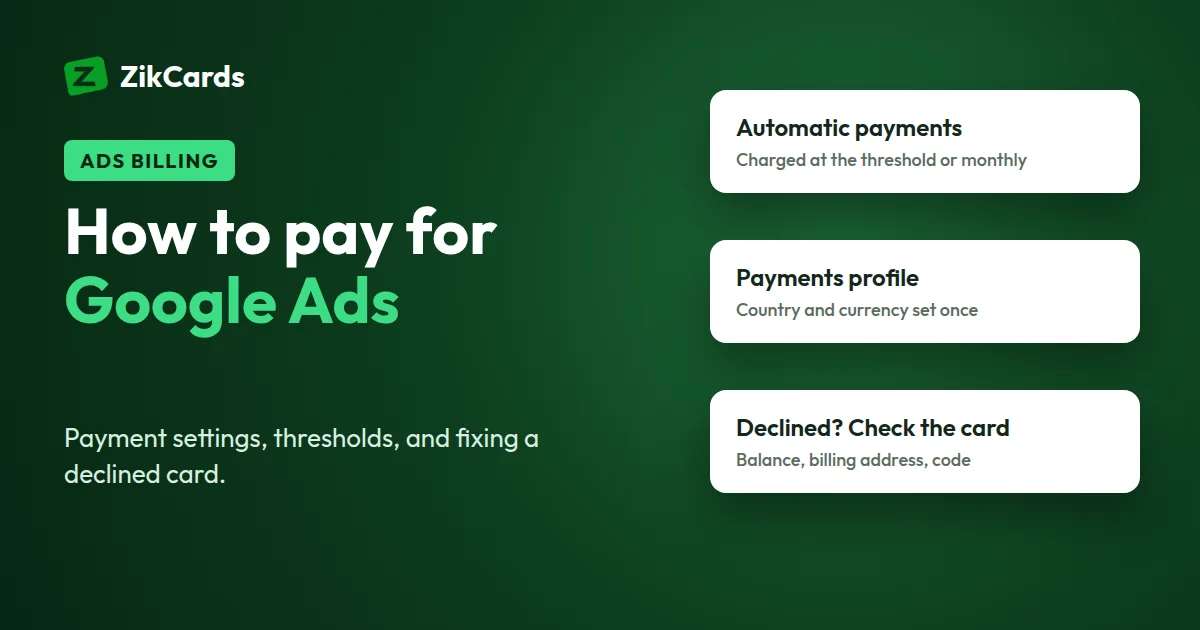
A virtual card for Google Ads is a card that exists only online, used to pay a Google Ads account. Advertisers use one when their local card is declined, when Google charges in the wrong currency, or when they want one card per ad account or client. This guide explains how Google Ads charges you, what the billing threshold is, what to look for in a virtual card for Google Ads, why payments are declined and how to fix them, and how to set one up with ZikCards.
How Google Ads charges you: three payment settings
When you set up billing, Google shows the payment settings and payment methods available for your country and currency. Not every account sees all three.
| Payment setting | When you pay | Who it suits |
|---|---|---|
| Automatic payments | After your ads run: when your costs reach your billing threshold, or 30 days after your last automatic charge, whichever comes first | Advertisers who pay by card and want Google to charge it as costs build up |
| Manual payments | Before your ads run: you add money first, and ads stop when it runs out | Advertisers who want a fixed amount and no automatic charges; available in some countries only |
| Monthly invoicing | After a monthly invoice, usually paid by bank transfer | Larger, established businesses that meet Google's requirements |
Some accounts can switch between automatic and manual payments later; others cannot. Check under Billing before your first campaign goes live.
How the Google Ads billing threshold works
With automatic payments, Google does not charge you for every click. It adds up your costs and charges your card when they reach your billing threshold, or 30 days after the last automatic charge if the threshold is not reached first.
- New accounts usually start with a low threshold. As you make payments on time, Google may raise it in steps. You can see your current threshold in your billing settings.
- A bigger budget means more charges. If your daily budget is high compared with your threshold, the threshold is reached in a few days, so you may be charged several times a month.
- The charge can be more than the ad spend. Depending on your country, Google may add tax, such as VAT or GST, to the amount charged.
- Daily spend moves around. On a single day Google can spend up to twice your average daily budget, but over a month you are not charged more than your average daily budget × 30.4.
To plan how much you will spend each month, use our Google Ads Cost & Budget Calculator. If you already have spend and click figures, the CPC calculator shows your real cost per click, and the break-even ROAS calculator tells you the return you need before a campaign makes money.
Your payments profile: country, currency and the verification charge
Your payments profile holds your name, address, country and payment methods. Two choices you make here are hard to undo:
- Country. The country of the payments profile usually decides which payment settings and methods you see, which Google company bills you, and which taxes apply. It generally cannot be changed later.
- Currency. The account's currency is set when you create the account and generally cannot be changed either. Choose it carefully before you finish sign-up.
The small verification charge. In some cases, when you add a card, Google makes a small temporary charge to check that the card is real and active. It is not a payment for ads and is normally reversed. The card needs enough balance for it, and the card issuer may ask for a one-time code at this step.
Why Google Ads payments are declined
Most declines on Google Ads come from a short list of causes:
- Not enough money for the full charge. The threshold charge plus any tax and fees is more than the card holds.
- A billing address that does not match. Google checks the address you entered against the one the card issuer holds.
- International or online payments are switched off on the card, or your bank limits foreign charges.
- A security check that did not finish. The card issuer asked for a one-time code or an approval and it was not completed in time.
- Google's own checks. Google may refuse a card because of where it was issued, or because a payment looks unusual.
Our guide to why cards are declined online explains common decline messages and the checks that fix most of them. Do not keep retrying the same card: repeated failures can look like fraud to payment systems.
What happens when a payment is declined
When an automatic charge fails, Google usually shows a payment notice in your account and emails you. It may retry the charge. If the balance stays unpaid, your ads can stop running until it is paid.
- Find the cause first from the list above. A retry on a card with the same problem only fails again.
- Fix it: add money to the card, correct the billing address, or switch on international payments.
- Pay the balance. In Billing, there is usually an option to make a payment. You can also add a working payment method and let Google charge it.
If Google suspends your account for suspicious payment activity or a policy reason, a different card will not change that decision. Follow the steps Google gives in your account and use its appeal process.
Advertiser verification is not a payment check
Google may ask you to complete advertiser verification: confirming who you are, or which business you represent, usually with documents. This is separate from billing. A card that works does not complete advertiser verification, and finishing verification does not fix a declined card. Answer each request on its own, with your real details.
What to look for in a virtual card for Google Ads
| Check | Why it matters for Google Ads |
|---|---|
| Issued in the US, in US dollars | A USD account charged to a USD card avoids conversion fees; the currency can't be changed after the account is set up. |
| Visa or Mastercard | Google Ads takes both networks. |
| 3D Secure | Google or the issuer may run a check that asks for a one-time code when you add the card or pay. |
| Its own billing address | The payments profile address should match the card's address. |
| Enough balance for the next charge | Google charges at the billing threshold or on the billing date, whichever comes first, in one go. |
| One card per account | Spend stays separate, and a problem on one account does not touch the others. |
Using a virtual card for Google Ads
A virtual card is a Visa or Mastercard with a number, expiry date and security code, used online like any card. For ad billing it has two practical advantages: it holds only what you load onto it, and you can give an ad account or a client a card of its own, so one budget never touches another.
A US card removes the most common reason cards from many countries are refused, the card's country, but Google runs its own checks on every card and every payment, so no card provider can promise acceptance.
How much to keep on the card. Keep the balance above your next automatic charge, plus anything added to it. A worked example, with a billing threshold of $200 (yours may differ):
| Item | Amount |
|---|---|
| Next charge at the billing threshold | $200.00 |
| Card issuer's cross-border fee, only if Google bills you from a company outside the US ($0.50 + 2.5%) | $5.50 |
| Kept on the card while it is open, returned when you close it | $1.20 |
| Balance the card needs before the charge | $206.70 |
Add any tax Google charges in your country on top; where the cross-border fee applies, it is worked out on the whole charge, tax included. Whether the cross-border fee applies depends on your country, because Google bills some countries through a company outside the US. Loading a card has its own fee, taken from your wallet; every fee is on the pricing page.
Why the margin matters. The card issuer charges $0.40 for every declined payment, taken from the card, and Google may retry a failed charge several times. A card topped up before the threshold costs nothing extra.
How to set up Google Ads billing with ZikCards
- Create an account and verify once. Sign up at zikcards.com and verify with a passport, national ID card or driving licence and a short selfie. See what ID you need.
- Add money to your balance. Your ZikCards balance is funded with USDT or USDC. Always send on the network you chose: which network to use.
- Create a card for this ad account. Choose Visa or Mastercard and load enough for the next charge, the fees above and the $1.20. The card is ready in seconds.
- Add the card in Google Ads. Open Billing and find Payment methods (menu names can change), then add a card. Enter the card number, expiry and security code from your card page, and the card's own billing address, shown on the same page with a copy button, not your home address. Why the billing address matters.
- Complete any security check. The payment may go through 3D Secure, a check that may ask for a one-time code. If it does, the code appears as a banner at the top of your ZikCards dashboard, and ZikCards never asks you for it. Where to find the code.
- Top up before each threshold. Check the card's balance against your threshold and your daily budget, and top up a day or two before a charge is due.
More on ad payments in our help answer: using ZikCards for ad accounts. When you stop advertising, wait until Google's last charge has gone through and any refund you expect has arrived, then close the card to return its balance to your wallet: freeze or close?
Frequently asked questions
Why was my Google Ads payment declined?
Usually the card did not hold enough for the full charge, the billing address did not match, international payments were off, or a security check was not completed. Fix the cause before you pay the balance again.
What is the billing threshold in Google Ads?
It is the amount of ad costs at which Google charges your card under automatic payments. You are charged when costs reach it, or 30 days after your last automatic charge, whichever comes first. New accounts usually start low, and Google may raise it over time.
Why did Google Ads take a small charge when I added my card?
In some cases Google makes a small temporary charge to check that a new card works. It is not a payment for ads and is normally reversed. The card needs enough balance for it to pass.
Do my ads stop if a payment fails?
Usually, if the balance stays unpaid. Google may retry the charge, and your ads can stop until the balance is paid. Once you pay it, ads normally restart.
Can I change my Google Ads currency or country?
Generally not. Both are set when you create the account and payments profile, which is why it is worth choosing them carefully at sign-up. If you think yours is wrong, ask Google's support what is possible for your account.
What is the best virtual card for Google Ads?
One that is issued in the US in US dollars, Visa or Mastercard, with 3D Secure, its own billing address and enough balance for your next charge, with a separate card for each ad account. No card provider can promise acceptance, because Google runs its own checks on every card and payment.
Can I pay for Google Ads with a virtual card?
You add a virtual card in Billing like any other card, with the card's own billing address. A US card removes the most common reason cards from many countries are refused, the card's country, but Google runs its own checks, so no card provider can promise acceptance.
Want your ad budget on a card of its own? Create your ZikCards account. See every fee on our pricing page.
Visa, Mastercard, Google and Google Ads are trademarks of their respective owners. ZikCards is not affiliated with or endorsed by them.