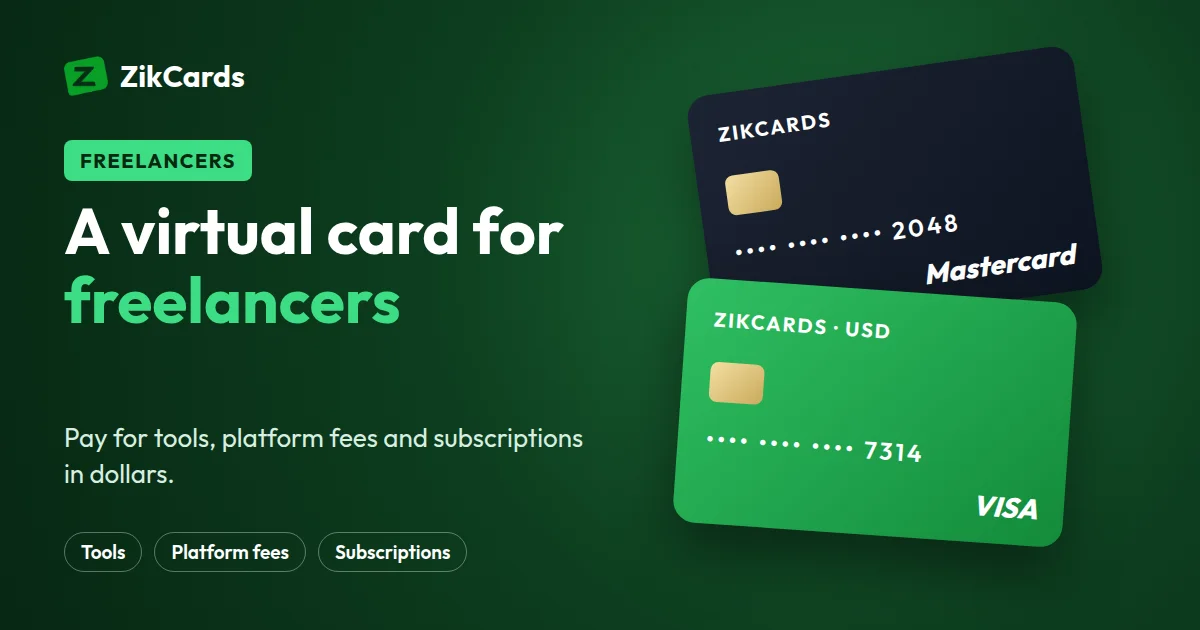
You win a client, and then the work has to be paid for in dollars: a platform membership, bids to send proposals, software, hosting, a stock photo. With a local bank card, some of those payments fail, cost extra in conversion, or stop at a code that never arrives. This guide covers what freelancers usually pay for in dollars, how to set up separate virtual cards for it, how to fund them with USDT or USDC, and what it all costs.
What freelancers pay for in dollars
Much of a freelancer's spending online is billed in US dollars, often by companies in the United States. The usual list:
- Freelance platform fees. Membership plans and paid bids, such as Upwork Connects for sending proposals or Fiverr's Seller Plus plan, and orders you place when you hire another freelancer for part of a job.
- Software and AI tools. Design, writing and coding tools, mostly monthly subscriptions. Our guide to paying for AI tools covers those in detail.
- Hosting and domains. Your portfolio site, and often servers or domains you set up for clients.
- Design assets. Stock photos, fonts, templates, icons and music licences.
- Courses. Online courses and certificates that keep your skills current.
- Ads for your own services. A small budget to find new clients. Our free tools include ad budget calculators to plan it, and our guides cover a virtual card for Facebook ads and a virtual card for Google Ads.
Why local cards get refused
- The card's country. Many US companies score every payment partly by the country where the card was issued, and cards from some countries are refused often, even with money on them.
- International payments switched off. Many banks issue cards with online or foreign payments disabled until you change it in the banking app.
- Conversion costs. A dollar price paid from a card in another currency goes through your bank's exchange rate and charges, so you pay more than the price and never quite know how much.
- The one-time code. Some payments run a security check that may ask for a one-time code, often sent by text message. If it arrives late or not at all, the payment fails.
Our guide to why cards are declined online covers each one. A US card removes the most common reason, the card's country, and a card that holds dollars pays dollar prices without your bank's currency conversion. But each platform runs its own checks, so no card provider can promise acceptance.
Paying, not receiving
Be clear about one thing before you sign up: ZikCards is for paying, not for getting paid. It is not a receiving account: it cannot receive payouts from freelance platforms, and clients cannot pay you into a card, your ZikCards balance or a ZikCards deposit address.
It cannot send money to other people either, so you cannot pay a subcontractor from it; money transfer is one of the purchase types the cards block. Keep using your platform's own withdrawal method or your bank for income, and use ZikCards for the money going out.
How to set up your cards
One card can do everything, but separate cards make freelance spending easier to manage:
- One card for platform fees. Memberships and bids in one place, so you can see what finding work costs you each month.
- One card for your tools. Subscriptions renew on their own dates. A card that holds only what they cost means a forgotten free trial can never take more than that. See virtual cards for subscriptions.
- One card per client project when you buy things for a client, such as hosting, a theme or stock images. Every charge on it belongs to that client, so rebilling is simple, and when the project ends you close the card.
Give each card a name ("Platform fees", "Tools", the client's name). You choose Visa or Mastercard each time; if one brand is refused, the other is worth one try (Visa or Mastercard?; more on a virtual Visa card and a virtual Mastercard).
How much to load. Load what you plan to spend plus $1.20. That $1.20 stays on each card while it is open and comes back to your wallet when you close it, so a card holding $31.20 can spend $30. Top the card up before each renewal date: the card issuer takes $0.40 from the card for every declined payment, and merchants often retry.
Closing a card is permanent and returns what is left to your wallet in full, with no fee. If you expect a refund on a client's card, wait until it lands: refunds go back to the card that was charged (how refunds work).
Paying Upwork and Fiverr with a virtual card
Freelance platforms charge sellers as well as buyers, and those charges need a card that works in US dollars.
| Platform | What you pay by card | Tip |
|---|---|---|
| Upwork | Connects for sending proposals, a Freelancer Plus membership, and contracts when you hire someone | Buy Connects in the amount you need; keep the card's balance above the next purchase plus $1.20 |
| Fiverr | Seller Plus, promoted gigs, and orders you place as a buyer | Use one card for platform fees only, so your records stay simple |
Enter the card's own billing address from the card page, not your home address. If a payment asks for a one-time code, it appears at the top of your ZikCards dashboard. Each platform runs its own checks, so no card provider can promise acceptance. A ZikCards card is for paying; it cannot receive your earnings from Upwork or Fiverr.
Funding your balance with USDT or USDC
ZikCards balances are funded with USDT or USDC (stablecoins); there are no bank, card or local-currency deposits. Some freelancers already hold stablecoins because a client pays them that way. That is an arrangement between you and your client, made outside ZikCards, which does not receive client payments. If you choose it:
- Agree it with the client first, and invoice as you would for any other payment method.
- Check the rules where you live. Rules on digital assets differ from country to country and change often, including how payments in them are taxed and must be reported. Check what applies to you, or ask a local adviser, before you accept one.
- Receive it in a wallet you control, or at an exchange that is allowed to serve your country. Never give a client a ZikCards deposit address: ZikCards does not accept client payments, and each address is valid only for one network and only for a short time.
- Deposit on the right network. USDT can be sent on BNB Smart Chain, Polygon, Solana, TRON or Ethereum; USDC on BNB Smart Chain, Polygon or Solana. Choose the network in ZikCards first, then send on exactly that network: a send on the wrong one is usually lost for good. See which network to use.
No client paying in stablecoins? Our guide on how to buy USDT explains how to get it through an exchange. ZikCards does not sell USDT or USDC.
Receipts, records and taxes
Separate cards make records easier, but they do not replace them:
- Keep the merchant's receipt or invoice for every purchase. Download them from each service's billing page every month.
- Export your ZikCards transactions. The Transactions page lists deposits, cards issued, top-ups and the fee on each, and you can export any date range as CSV or PDF. Each card's own page lists what that card spent. See where to find your transactions.
- Note stablecoin payments when you receive them, with the date, the amount and the invoice they paid.
Tax rules for freelance income and costs differ in every country, and we cannot advise on them. Check your local tax rules, or ask a local accountant or tax adviser, about what to claim and report.
What it costs: a real example
Say you want $60 a month for platform fees and tools on one card. These are ZikCards' published fees; every one is on the pricing page.
| Step | Amount |
|---|---|
| Add $70 to your balance (deposit fee from $1 + 1%, depending on the network) | you send from $71.70 in USDT or USDC |
| New card, one-time | $5 ($3 with a discount code on your first card) |
| Load $61.20 onto the card (3% loading fee) | $63.04 from your balance |
| Kept on the card while it is open, returned when you close it | $1.20 |
| Available to spend on the card | $60.00 |
| Left in your wallet | $1.96 ($3.96 with a code) |
| Monthly card fee | none |
The next month costs less: no card fee, and the $1.20 is already on the open card. Loading another $60 makes $60 available to spend again and costs $61.80 from your balance, plus the deposit fee on what you add.
Two card issuer fees to plan for. Purchases that settle outside the US carry a cross-border fee of $0.50 + 2.5%, taken from the card; some services bill through a company in another country, so keep a little extra on the card for them. And each declined payment costs $0.40 from the card, retries included, so stop after two or three declines and check the reason. Declines in blocked categories are free.
How to start with ZikCards
- Sign up and verify once. Create an account at zikcards.com and verify with a passport, national ID card or driving licence and a short selfie on your phone. Most verifications are approved automatically within minutes. See what ID you need.
- Add USDT or USDC to your balance, on the network you chose.
- Create a Visa or Mastercard and load what you plan to spend plus $1.20. The card is ready in seconds; give it a name on the My cards page.
- Pay with the card's own billing address. At checkout, enter the card number, expiry and security code, and the billing address shown on the card page, not your home address. Why the billing address matters.
- Enter a code if asked. Some payments run a 3D Secure check that may ask for a one-time code. It appears as a banner at the top of your ZikCards dashboard, and ZikCards never asks you for it. More in our guide to the 3D Secure virtual card.
Frequently asked questions
Can I receive payments from Upwork or clients on ZikCards?
No. ZikCards is for paying online, not for receiving money. It cannot accept payouts from freelance platforms or payments from clients. If a client pays you in USDT or USDC, you arrange that yourself, into your own wallet, never into a ZikCards deposit address, and can then deposit it to your ZikCards balance.
Can I buy Upwork Connects or pay Fiverr with a ZikCards card?
A US card removes the most common reason cards from many countries are refused, the card's country, but each platform runs its own checks on every card and payment, so no card provider can promise acceptance. Use the card's own billing address and keep enough on it for the full amount.
Is there a monthly fee?
No. You pay $5 once per card ($3 for your first with a discount code), a deposit fee from $1 + 1%, and 3% to load a card. The issuer's cross-border and decline fees are on the pricing page.
Can I pay a subcontractor with ZikCards?
Not directly. You cannot send money to another person or to another ZikCards account, and money transfer services are blocked on the cards. If you hire someone through a freelance platform, you pay the platform at its checkout like any other purchase, subject to its own checks.
Will ZikCards help with my tax records?
It makes records easier: you can export your transactions as CSV or PDF, and each card lists its own spending. It does not replace merchant receipts, and we cannot give tax advice, so check your local tax rules.
Ready to keep your freelance spending in one place? Create your ZikCards account. See every fee on our pricing page.
Visa, Mastercard, Upwork and Fiverr are trademarks of their respective owners. ZikCards is not affiliated with or endorsed by them.