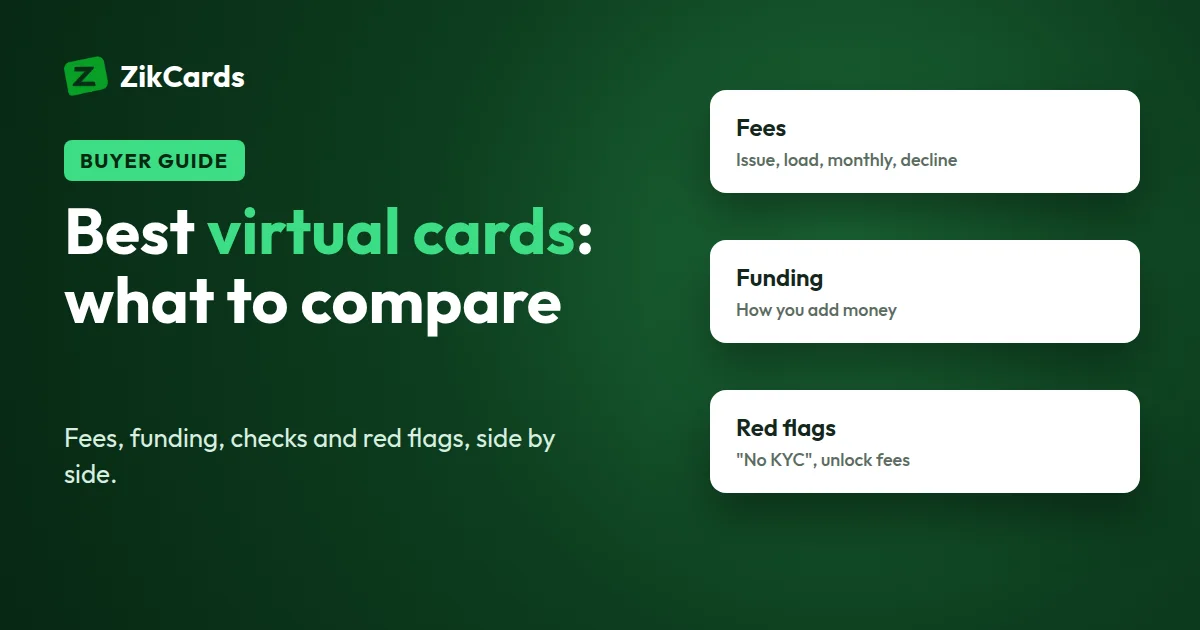
Search for the best virtual cards and you will find long lists, bright promises and very few clear answers. The truth is that no single card is best for everyone. The best virtual card for online payments is the one whose country, fees, funding and rules fit what you actually buy. This guide gives you the criteria that matter, the red flags to walk away from, a checklist you can use on any provider, and an honest look at how ZikCards scores on each point, including its limits.
Best virtual card providers compared
The figures below are taken from each provider's own website, checked on 29 October 2026. Prices change, so check the provider's site before you sign up. ZikCards is our own service.
| Provider | Card fee | Monthly fee | Loading / deposit fee | Funding | ID check | Who can sign up |
|---|---|---|---|---|---|---|
| ZikCards | $5 once | None | 3% to load a card (+$1 under $100); deposit $1 + 1% | USDT, USDC | Yes | The US and most countries |
| Privacy.com | Included in plan | Free plan; paid plans $5 / $10 / $25 | None; spending is debited from your bank | US bank account or US debit card | Yes | US citizens and residents with a US bank account |
| Halocard | $0 | $15 / $20 / $75 subscription; no free plan | USDT/USDC 0%; card or Apple/Google Pay 5%; BTC/ETH/SOL 1% | Stablecoins, crypto, cards, ACH, wire, SEPA | Yes | The US (except 19 states) and 120+ countries |
| US Unlocked | 1 card included; extra cards $1/month | $4.95/month or $39.95/year | Crypto 2%; card or Apple/Google Pay $1 + 5% | Crypto, cards, SEPA, UK Faster Payments | Yes | Non-US residents only |
| PST.NET | From $1; $7–$16 by card | The card fee repeats every 30 days | At least $1 per load (rate shown inside the account) | Crypto (per its terms) | Yes | Not open in the US, Canada, China, Russia, Ukraine and others |
| ePN | $2–$4 by tier | $2–$4 per card | 3%–6.7% by tier; $50 minimum deposit | Not stated | Yes | Not stated |
| Pay2.House | $5 | $5 per card; plans $149–$749/month | 3%–4% | USDT (TRC-20) | Yes | No country list published |
| Finup | $10 at entry level, lower at higher spend | No card monthly fee stated | Deposit 5% / 3% / 2% by level; $1.20 per transaction at entry level | USDT, BTC, ETH and other coins | Its pages differ | 18+; 29 countries excluded |
| Spendge | 5 EUR | Its page does not say whether the 5 EUR repeats monthly | Crypto 1%; card 3%; bank wire 0% | USDT (TRC-20), SEPA bank transfer | Not stated for individuals | No country list published |
Which suits whom:
- ZikCards: pay as you go, no monthly fee, funded with USDT or USDC; US-issued Visa and Mastercard.
- Privacy.com: US residents who want cards drawn on their own US bank account.
- Halocard: people who fund in stablecoins often and are fine with a monthly subscription.
- US Unlocked: non-US residents who want a subscription service with several funding options.
- PST.NET, ePN, Pay2.House, Finup, Spendge: ad and media-buying teams. Compare the per-card monthly fees and tiers carefully.
What makes the best virtual cards different
Most virtual cards look the same on the surface: a 16-digit number, an expiry date and a security code on a screen. The differences sit underneath, in who issues the card, where it is issued, what it costs to keep and how you get money onto it. Two cards with the same logo can behave very differently at checkout.
So before you compare logos or designs, compare issuers and rules. If you are new to the idea, start with what a virtual card is, then come back to the list below.
Issuing country and BIN
The first six to eight digits of a card number are the BIN (bank identification number). They tell a merchant which network the card belongs to, which country it was issued in and whether the range is registered as credit, debit or prepaid. Some merchants check the card's country against what they expect, so the issuing country matters more than most people think.
- Ask where the card is issued. A clear provider says it on its website. A vague answer is a warning sign.
- Check it yourself. Once you have a card, type its first digits into a BIN lookup to see the country and card type a merchant sees.
- Know the difference between credit, debit and prepaid ranges. Our guide on prepaid vs credit BIN explains what the registration means and what it does not mean. More detail on the digits themselves is in what is a BIN number.
Card network: Visa or Mastercard
Online, both networks are accepted almost everywhere cards are taken. A provider that lets you choose the network each time you create a card gives you a simple fallback if one payment is refused. Our Visa vs Mastercard virtual card guide covers the few real differences.
Fees: read the whole list, not the headline
A low creation fee can hide a high monthly fee, and a free card can hide costly loading. Look for every one of these on the provider's pricing page:
- Issue fee: what it costs to create a card.
- Load fee: what it costs to move money onto a card.
- Deposit fee: what it costs to fund your account in the first place.
- Monthly fee: charged whether you use the card or not. Over a year this can be the largest cost.
- Cross-border or FX fee: charged when a merchant settles outside the card's country or in another currency.
- Decline fee: some issuers charge a small fee for every refused payment, including retries.
- Withdrawal or closing fee: what it costs to get unused money back.
If a provider does not publish all of these in one place, ask before you deposit anything.
Funding methods
How you put money on the card decides whether the card is useful to you at all. Some providers take bank transfers, some take other cards, some take stablecoins. Pick a method you can use cheaply and legally where you live. If you have no bank account, see our guide to a virtual card without a bank account.
Identity checks (KYC)
A licensed card issuer has to know who its customers are. That means a real provider asks for ID. A good one makes it quick: a photo ID and a selfie, checked in minutes. Treat a quick check as a good sign, not a nuisance.
Security: 3D Secure and card controls
- 3D Secure. Many shops run a check that may ask for a one-time code. Ask where that code is delivered, and make sure it reaches you reliably. Our 3D Secure guide explains how it works.
- Freeze and close. You should be able to freeze a card at once and close it for good.
- Separate cards. One card per subscription or service limits the damage if a merchant is breached. See our guide on a virtual card for subscriptions.
Wallets, refunds, number of cards and support
- Wallet support: can the card be added to Apple Pay or Google Pay for in-store payments?
- Refunds: where does a merchant refund land, and what happens if the card is already closed? Our virtual card refunds guide covers this.
- How many cards: if you run several ad accounts or clients, check how many cards you can hold at once.
- Support: is there a real help centre, and can you reach a person when a payment is stuck?
Best virtual card for small business and ads
People searching for the best virtual card for small business or the best virtual card for ads usually need three extra things: several cards, clear spending per card, and predictable costs when an ad account bills often. A card that charges a monthly fee per card gets expensive fast across many accounts. A decline fee matters more when a platform retries a failed charge. Each ad platform runs its own checks, so no card provider can promise acceptance; choose on rules and fees, not on promises. The ads budget calculator helps you plan your spend. On ZikCards, load that amount plus the $1.20 that stays on the card while it is open; the 3% load fee is taken on top from your balance.
Red flags to walk away from
- Claims that no ID check is needed. A licensed issuer cannot offer this. Either the card is not what it claims, or it will be shut down later with your money on it.
- Promises of no limits at all. Every real card has limits set by the issuer. A promise of none is a sales line.
- Promises that a card will work on a named site. No provider controls another company's checks.
- Asking for card details or codes by chat. A real provider never asks for your full card number, security code or one-time code on WhatsApp, Telegram or anywhere else.
- Upfront "unlock" or "activation" payments. Paying a stranger to release a card or a balance is a common scam.
- No company name or pricing page. If you cannot see who runs it and what it costs, do not send money.
Checklist: compare any virtual card provider
| Criterion | What to look for |
|---|---|
| Issuing country | Stated clearly; matches what you buy |
| Card type (BIN) | Shown by a BIN lookup; described honestly |
| Network | Visa, Mastercard, or a choice of both |
| Fees | Issue, load, deposit, monthly, cross-border, decline and withdrawal all published |
| Funding | A method you can use cheaply where you live |
| Identity check | Required, quick and done in the app |
| 3D Secure | Supported, with a clear way to receive codes |
| Wallets | Apple Pay or Google Pay if you need in-store payments |
| Refunds | Clear rule on where refunds land |
| Number of cards | Enough for your accounts or clients |
| Support | Help centre plus a way to reach a person |
How ZikCards scores, honestly
Here is how ZikCards measures up on the same list, including where it falls short.
| Criterion | ZikCards |
|---|---|
| Issuing country | USA, through a licensed US partner institution. ZikCards is not a bank. |
| Card type (BIN) | Registered with the networks as a US credit BIN, but no credit is given: each card is loaded from your balance and spends only what is on it. No bill, no interest, no credit check. |
| Network | Choose Visa or Mastercard each time you create a card. |
| Fees | Card creation $5 one-time (first card $3 with a $2-off code), 3% to load a card, deposits from $1 + 1%, no monthly fee. Issuer fees: $0.40 per declined payment, $0.50 + 2.5% when a merchant settles outside the US. All on the pricing page. |
| Kept balance | $1.20 stays on each open card and is returned when you close it, so you can spend your card balance minus $1.20. |
| Funding | USDT (BNB Smart Chain, Polygon, Solana, TRON or Ethereum) or USDC (BNB Smart Chain, Polygon or Solana) only. No bank, card or local-currency deposits. |
| Identity check | Photo ID and a short selfie; most are approved within minutes. |
| 3D Secure | On every card. Codes appear on your dashboard and, if you connect it, in Telegram. |
| Wallets | A card can be added to Apple Pay or Google Pay. |
| Refunds | Go back to the card that was charged; keep it open until they arrive. |
| Number of cards | Your limit is shown on your My cards page. |
| Support | Help centre with answers to common questions. |
The limits, plainly: you can only fund with stablecoins; the cards are for spending, not for receiving payments or salaries; there is no cash or ATM use; some merchant groups are always blocked, such as gambling and money transfer (see the full list); and the decline fee means it pays to fix a refused payment before retrying many times. Our guide to why cards are declined online helps with that.
Frequently asked questions
Which virtual card provider has no monthly fee?
In the table above, ZikCards has no monthly card fee, and Privacy.com has a free plan. Halocard and US Unlocked charge a monthly subscription, and PST.NET, ePN and Pay2.House charge a per-card fee each month (figures as published on 29 October 2026).
What are the best virtual credit cards for online payments?
There is no single best one. Compare the issuing country, the full fee list, how you fund it, the identity check and 3D Secure support. The card that fits your purchases and funding method is the best one for you.
Does a credit BIN mean the card gives you credit?
No. The BIN only shows how the card range is registered with the network. A ZikCards card is loaded from your balance first and spends only what is on it. No credit line is given.
Can a virtual card work without ID?
Not from a licensed issuer. Real providers must check who you are. Be careful with any offer that says no ID is needed.
Which virtual card is best for ads?
Look for no monthly fee per card, several cards, clear decline fees and reliable 3D Secure codes. Each ad platform runs its own checks, so no card provider can promise acceptance.
How do I check a virtual card's country?
Enter the first digits into our free BIN checker. It shows the network, country and card type that merchants see.
Can I receive money on a ZikCards card?
No. The cards are for paying online and, through a wallet, in shops. To get money back off a card, close it and the remaining balance returns to your wallet with no fee.
Ready to compare for yourself? Create your ZikCards account. See every fee on our pricing page.
Visa, Mastercard, Apple Pay, Google Pay, WhatsApp, Telegram, Privacy.com, Halocard, US Unlocked, PST.NET, ePN, Pay2.House, Finup and Spendge are trademarks of their respective owners. ZikCards is not affiliated with or endorsed by them.