Many US platforms, ad networks and software tools refuse cards issued in some countries, even when the money is there. That is why people look for a US-issued virtual card: a USD Visa or Mastercard whose issuer is in the United States. This guide explains what "US-issued" really means, why the card's country matters to merchants, how to check where any card was issued, what a USD card saves you, and how to get one from the US and almost every other country.
What "US-issued" means
Every card is issued by a bank or licensed institution in a particular country. The first six to eight digits of the card number, the BIN, tell the payment networks and every merchant who issued the card and where. A US-issued card is one whose BIN belongs to an issuer in the United States.
That is a fact about the card, not about you. A US-issued card does not make its holder a US resident, and the provider that gives you the card is not always the issuer. Many card apps work with a licensed issuing institution behind the scenes. The card's country is the issuer's country.
Our guide what is a BIN number explains the digits in more detail.
Why the card's country matters to merchants
When you pay, the merchant sees the card's country before anything else. Many US businesses, and many online platforms elsewhere, decline or add checks to cards from countries where they see more fraud or more failed payments. This is a business rule, not a judgment about you, and it explains a common frustration: the card has money on it, the details are right, and the payment is still refused.
A US-issued card removes that reason. Each merchant still runs its own checks, such as the billing address, 3D Secure and its own risk rules, so no card provider can promise acceptance. But the card's country stops being the first thing that goes wrong.
How to check where a card was issued
- Take the first six digits of the card number.
- Enter them in a free BIN lookup. It shows the network, the card type the issuer registered, the issuing institution and the country.
- Check the result before you buy a card from any provider. If a provider says "US card" and the lookup shows another country, ask why.
Never type a full card number into a lookup site. The first six digits are enough.
What a USD card saves you
Most US platforms and many international ones price in US dollars. Paying a dollar price from a card that holds dollars means no currency conversion on each charge. With a card in another currency, the card network converts every payment at its own rate, and your bank may add a foreign transaction fee of 2-3% on top.
Two costs can remain on a USD card:
- Merchants that settle outside the US. Some platforms bill through a company in another country even when they charge in dollars. Card issuers usually charge a cross-border fee on those payments. On ZikCards cards it is $0.50 + 2.5%, taken from the card.
- Prices in other currencies. If a merchant charges in euros or pounds, the payment is converted, whatever card you use.
Who uses a US-issued virtual card
- Advertisers and media buyers paying ad platforms that bill in dollars. Our virtual card for ads guide covers the setup, and there are step-by-step guides for a virtual card for Facebook ads and a virtual card for Google Ads.
- Freelancers and small businesses paying for software, hosting, domains and AI tools.
- People with subscriptions to US services who want one card per subscription.
- Anyone without a dollar bank account, or whose bank blocks international payments. See a virtual card without a bank account.
What to check before you choose a provider
- The issuing country, with a BIN lookup, as above.
- All fees, published in full: card creation, loading, monthly fees, declines, cross-border, withdrawals.
- Verification. A real issuer asks who you are. A provider promising cards with no identity check is a warning sign.
- 3D Secure, which many merchants now require (see the 3D Secure virtual card).
- A billing address on file for each card, for address checks: virtual card with a US billing address.
- How you get your money back: closing a card, refunds and withdrawals.
Our guide to comparing virtual cards has a full checklist.
A US-issued virtual card with ZikCards
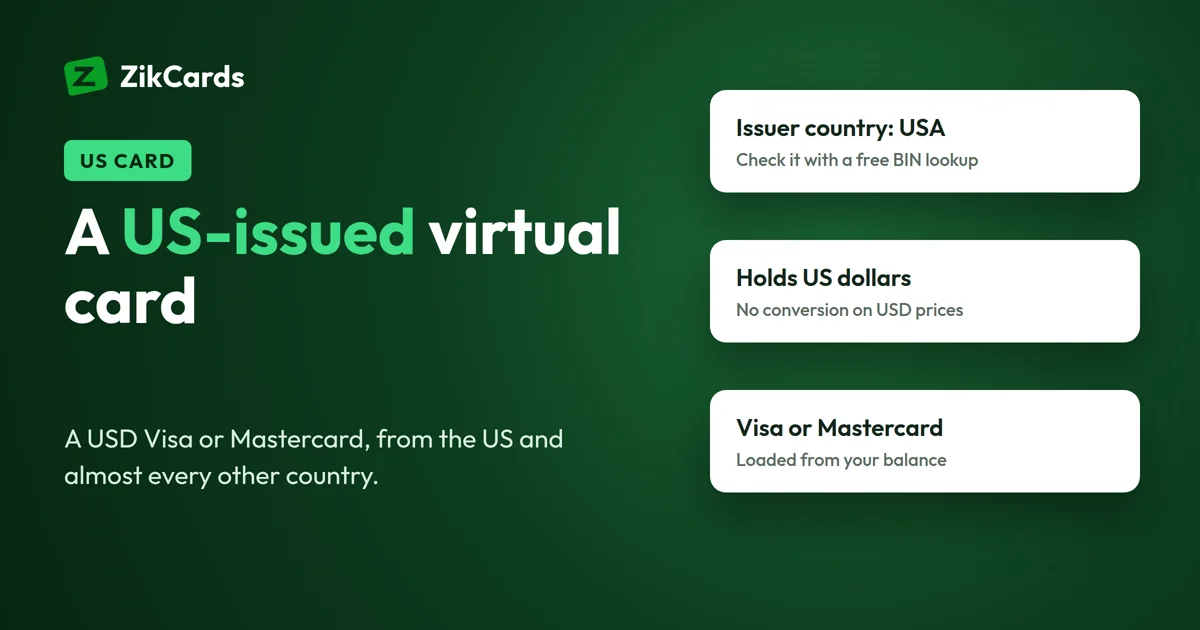
ZikCards issues US Visa (4865**) and Mastercard (5371**) virtual cards in US dollars, to people and businesses in the US and almost every other country. A BIN lookup on either shows a US issuer.
- Funded from your balance. The cards are on a US credit BIN, loaded from your balance, with no credit line, no bill and no interest. You add USDT or USDC to your balance, then load a card.
- Ready in seconds after a one-time identity check, with a US billing address and 3D Secure on every card.
- Your choice of network each time you create a card: virtual Visa card or virtual Mastercard.
- Published fees: $5 per card once, 3% to load a card, a deposit fee from $1 + 1%, and no monthly card fee. $1.20 stays on each card while it is open and comes back when you close it.
In a few countries where our main card issuer is not available, cards come from a second issuing partner. Those are USD Visa cards, and the Issue card page shows where each one is issued and its fees before you pay.
How to get one
- Sign up and verify once with a photo ID (passport, national ID card or driving licence) and a short selfie on your phone. Most verifications are approved automatically within minutes: what ID you need. No SSN is needed; see a virtual card without an SSN.
- Add USDT or USDC to your balance. USDC works on BNB Smart Chain, Polygon and Solana. Always send on the network you chose: which network to use. New to stablecoins? Read how to buy USDT.
- Create a card, Visa or Mastercard, and load what you plan to spend plus $1.20.
- Pay with the card's own details, including the billing address from the card page. If a 3D Secure check asks for a one-time code, it appears at the top of your dashboard.
Frequently asked questions
Can I get a US-issued virtual card if I don't live in the US?
Yes, from providers that serve your country. ZikCards serves the US and almost every other country; check where it is available.
What is a USD virtual card?
A virtual card that holds US dollars, so dollar prices are paid without currency conversion. Most US-issued cards are USD cards.
How do I know if a card is really issued in the US?
Enter its first six digits in a free BIN lookup. The result shows the issuer's country.
Will a US card work on every US website?
It removes the most common reason cards from abroad are refused, the card's country, but each merchant runs its own checks, so no card provider can promise acceptance.
Do I need a US bank account or a US address?
No. You fund your ZikCards balance with USDT or USDC, and each card comes with its own US billing address to use at checkout.
How much does a US-issued virtual card cost with ZikCards?
Creating a card costs $5 once, and loading money onto it costs 3%. Adding money to your balance costs from $1 + 1%, depending on the network. There is no monthly card fee. The card issuer charges $0.40 for each declined payment and $0.50 + 2.5% on purchases that settle outside the US, both taken from the card. Every fee is on the pricing page.
Is a US-issued virtual card a credit card?
Not in the sense of borrowing. ZikCards cards are issued on a US credit BIN, but no credit is given: each card spends only what you load onto it.
Ready for a US card in your own name? Create your ZikCards account. See every fee on our pricing page.
Visa and Mastercard are trademarks of their respective owners. ZikCards is not affiliated with or endorsed by them.