You try to pay a foreign website in dollars, and your Indian card is refused, or the payment goes through and your bank charges more than the price. Freelancers, developers, sellers and agencies in India meet this often: many cards are switched off for international use, monthly renewals need an e-mandate, and some cards are not accepted abroad at all. This guide explains why Indian cards fail on foreign sites, how a virtual card in India works, how to get one and what it really costs.
Why Indian cards are refused on foreign websites
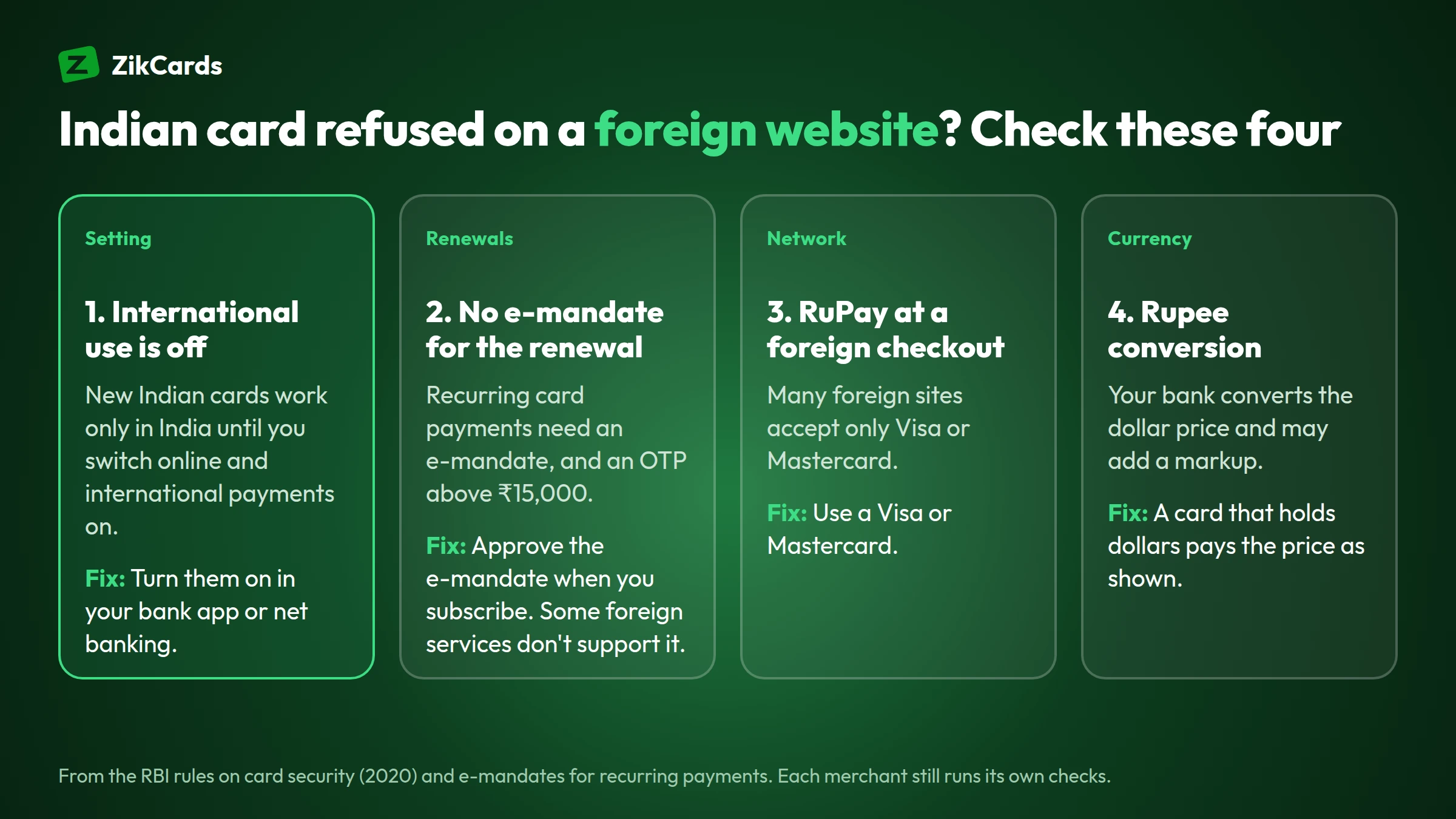
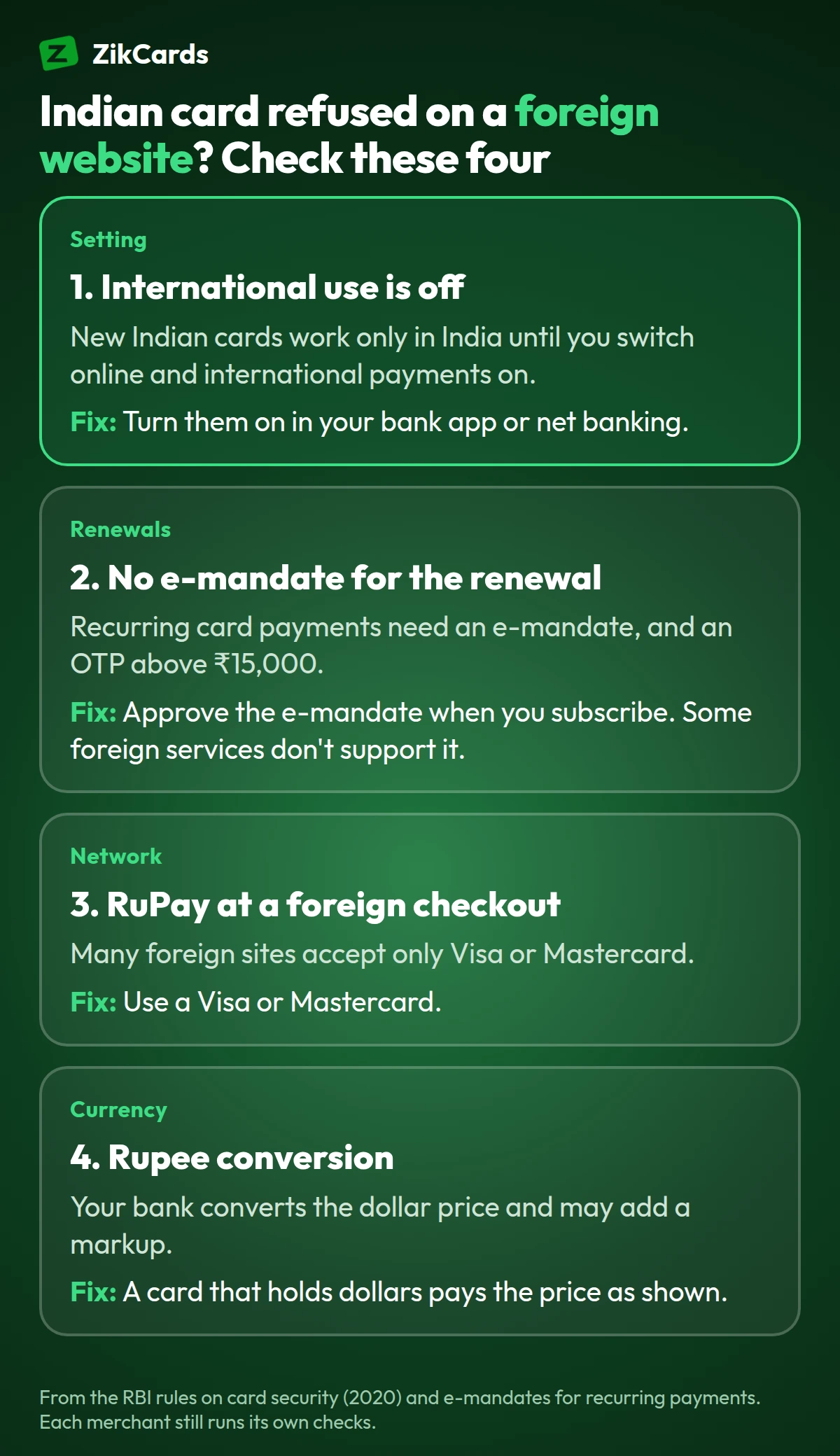
Most refusals come from one of five settings or rules, and each one has a different fix. Check them in this order before you try again:
- International and online use is switched off. Under a Reserve Bank of India rule from 2020, new and reissued cards work only at ATMs and shops in India until you turn on online and international payments. Cards that were never used online or abroad were switched off too. You can turn these on in your bank's app or net banking.
- Monthly renewals need an e-mandate. Recurring card payments in India must be registered as an e-mandate, with an extra check when you set it up. Renewals above ₹15,000 need a one-time password each time. When a foreign service does not bill in the format Indian banks require, the renewal is declined, even with money in your account.
- The card network. Visa and Mastercard are accepted almost everywhere online. RuPay works well on Indian websites, but many foreign checkouts don't accept it, or accept it only through a partner network.
- Conversion from rupees. A dollar price on a rupee card is converted at your bank's rate, and many banks add a foreign currency markup. The amount taken from your account can be more than the price you saw.
- The card's country and the merchant's checks. Many payment systems look partly at where a card was issued. Some foreign services also refuse cards whose billing details don't match the account, or ask for a check that may send a one-time code.
If your card is refused somewhere specific, our guide on why cards are declined online goes through every decline message and what to do about each.
How a virtual card in India works
A virtual card is a real Visa or Mastercard with a card number, expiry date and security code, but no plastic. You pay online with it like any other card. If the idea is new, read what a virtual card is.
With ZikCards you get a dollar card that you load from your own balance first. The merchant charges the card in dollars, so there is no rupee conversion at checkout, and you can only spend what is on the card. There is no bill, no interest and no credit line.
When you choose a virtual card provider in India, ask these questions:
- Where is the card issued? ZikCards offers US-issued Visa and Mastercard cards and a Singapore-issued Visa. The Issue card page shows each card's country, fees and what it is used for, before you pay.
- Is there a monthly fee? A monthly fee on every card adds up if you keep one card per client or per tool. ZikCards has none.
- Can you get your money back? On ZikCards, closing a card is free and returns its balance to your wallet.
- Does it support 3D Secure? Some checkouts run a check that may ask for a one-time code. Cards that support it show it on the Issue card page. See how 3D Secure works on a virtual card.
Virtual Visa card or Mastercard in India?
For most people in India either works, because both brands are accepted almost everywhere online. If a payment is refused on one brand, a card of the other brand is worth one try before anything else. You choose the brand each time you create a card, so you can keep one of each. Read more about a virtual Visa card, a virtual Mastercard, or our Visa vs Mastercard comparison.
How to get a virtual card in India with ZikCards
The first card takes about 5 minutes: sign up, verify, add money and create the card.
- Sign up and verify once. Create an account at zikcards.com and verify with your passport, Aadhaar card or driving licence and a short selfie on your phone. A PAN card is not accepted. Most verifications are approved automatically within minutes. You must be 18 or older. See what ID you need.
- Add USDT or USDC to your balance. ZikCards is funded with USDT (on BNB Smart Chain, Polygon, Solana, TRON or Ethereum) or USDC (on BNB Smart Chain, Polygon or Solana). The minimum deposit is $20. There are no rupee, UPI, bank or card deposits. Always send on the network you chose: which network to use.
- Create a Visa or Mastercard. Choose the card and load the amount you plan to spend. On the US cards, $1 stays on the card while it is open, so load the price plus $1. The card is ready in seconds. You can name it on the My cards page afterwards, for example after the client or tool it is for.
- Pay in dollars. Enter the card number, expiry and security code at checkout. When the card page shows a billing address, use that address, not your home address in India: why the billing address matters.
If a merchant runs a check that asks for a one-time code, the code appears at the top of your ZikCards dashboard, and in Telegram if you have connected it. ZikCards never asks you for this code: what to do when a merchant asks for a code.
How people in India get USDT or USDC
ZikCards doesn't sell USDT or USDC. Most people get it in one of two ways:
- An exchange that is allowed to serve India. Buy with rupees on the exchange, or on its P2P marketplace, where the exchange holds the seller's USDT or USDC until the seller confirms your payment. Choose sellers with many completed trades and a high completion rate.
- From someone you already work with, such as a foreign client who pays you in USDT or USDC.
Before you buy:
- Check India's crypto rules before you buy.
- Keep the whole trade inside the exchange. Pay only the account named in the order, talk only in the exchange's own chat, and never move a trade to WhatsApp or Telegram. Fake payment screenshots and off-platform deals are the usual P2P scams.
- Withdraw on the same network you will deposit on, and check the exchange's withdrawal fee first. A transfer sent on the wrong network is usually lost.
What it costs: a real example
ZikCards cards cost $5 to create, with no monthly fee. Say you pay $100 a month for tools and ads on a US card. These are the published fees; every one is on the pricing page.
| Step | Amount |
|---|---|
| Add $111 to your balance (deposit fee from $1 + 1%, depending on the network) | you send from $113.11 |
| New card, one-time | $5 ($3 with a discount code) |
| Load $101 onto the card (3%) | $104.03 from your balance |
| Kept on the card while it is open, returned when you close it | $1.00 |
| Available to spend | $100.00 |
| Monthly card fee | none |
Two fees to plan for. Purchases that settle outside the US carry the card issuer's cross-border fee: $0.50 + 2.5% on the US cards and 1.5% on the Singapore Visa. Top-ups under $100 also carry $1. Your cost in rupees depends on the price you pay for USDT or USDC, so compare a few sellers before you buy.
Works with Google, Apple Pay and Google Pay
Our cards work with Google Ads, Facebook Ads, ChatGPT, Claude, Google Play and Google Workspace: we have seen real payments go through on each of them. Each platform still runs its own checks on your account, so no card provider can promise that a payment will be accepted. If you advertise, see how to use a virtual card for Google Ads or a virtual card for Facebook ads.
Every card can also be added to Apple Pay and Google Pay, so you can pay with your phone where those are accepted. Add it by hand with the card details: how to add a virtual card to Apple Pay or Google Pay.
Check the service is available in India. A card changes how you pay, not where a service operates. If a platform does not offer its service in India, a different card won't change its rules.
Tips that save money and trouble
- Keep the card funded before renewals. Some cards charge a fee when the same purchase is declined repeatedly. On the US cards a decline is free and only a repeat of the same payment costs $0.75; on the Singapore Visa each payment costs $0.30, declined ones included.
- Stop after two or three declines. Repeated failures look like fraud to payment systems. Find the reason first, then try again.
- Use one card per job. A separate card for each client, ad account or subscription keeps budgets apart. A forgotten trial can only take what is on that card. See a virtual card for subscriptions.
- Close cards you no longer need. Closing is free, stops all charges and returns the balance to your wallet. Keep a card open until any expected refund has arrived: freeze or close?
Frequently asked questions
Is ZikCards available in India?
Yes. India is not on our restricted countries list, and both the US-issued cards and the Singapore Visa are offered to customers in India. See is ZikCards available in my country.
How to pay in dollars from India?
Turn on international and online use on your Indian card first, then try again. If the merchant still refuses it, or renewals keep failing, a dollar virtual card loaded from your own balance pays the merchant in dollars without a rupee conversion at checkout.
Is it a virtual credit card or a virtual debit card?
Neither in the usual sense. You load the card from your ZikCards balance first and can only spend what is on it. There is no bill, no interest and no credit check.
Can I get a virtual Visa card in India?
Yes. When you create a card you choose a Visa or a Mastercard, and you can keep one of each.
Can I fund it with rupees, UPI or my bank account?
No. ZikCards balances are funded with USDT or USDC only. You buy those on an exchange that is allowed to serve India.
Is it an international debit card from an Indian bank?
No. Indian banks issue international debit cards linked to your bank account. A ZikCards card is a separate dollar card that you load from your ZikCards balance, so your bank account is never charged by the merchant.
Can I receive payments on it?
No. It is a card for paying online, not an account for receiving money from clients or freelance platforms.
Paying foreign websites from India? Create your ZikCards account. See every fee on our pricing page.
Visa, Mastercard, RuPay, Apple Pay, Google Pay, Google Ads, Google Play, Google Workspace, Facebook, ChatGPT, Claude, WhatsApp and Telegram are trademarks of their respective owners. ZikCards is not affiliated with or endorsed by them.