You hold USDC and want to pay for things online with it: a software plan, a hosting bill, a course, or a shop that takes only cards. Most websites do not take stablecoins, so people search for a USDC debit card or a USDC Visa card. This guide explains how spending USDC with a card really works, what happens to your money between the wallet and the checkout, which networks to use, how USDC compares with USDT, and what it costs with ZikCards.
How a USDC card really works
No card spends USDC directly at the checkout. Card payments run on the Visa and Mastercard networks, and those networks settle in normal currencies such as US dollars. So every "USDC card" works in two steps, even when the app hides them:
- Your USDC becomes a dollar balance. You send USDC to the provider, and it is credited to your account as US dollars.
- The card spends dollars. The card is loaded from that balance and the merchant is paid in dollars, like any other card payment.
Because USDC is designed to track the US dollar one to one, this step is simple to follow: the dollar amount you see on your balance is close to the amount of USDC you sent, minus the deposit fee. There is no exchange rate guesswork, which is the main reason people prefer stablecoins to other crypto for spending.
The merchant never sees crypto. It sees a normal Visa or Mastercard payment in US dollars. That also means the card follows normal card rules: billing address checks, a 3D Secure check that may ask for a one-time code, and refunds back to the card.
Spend USDC with ZikCards: the steps
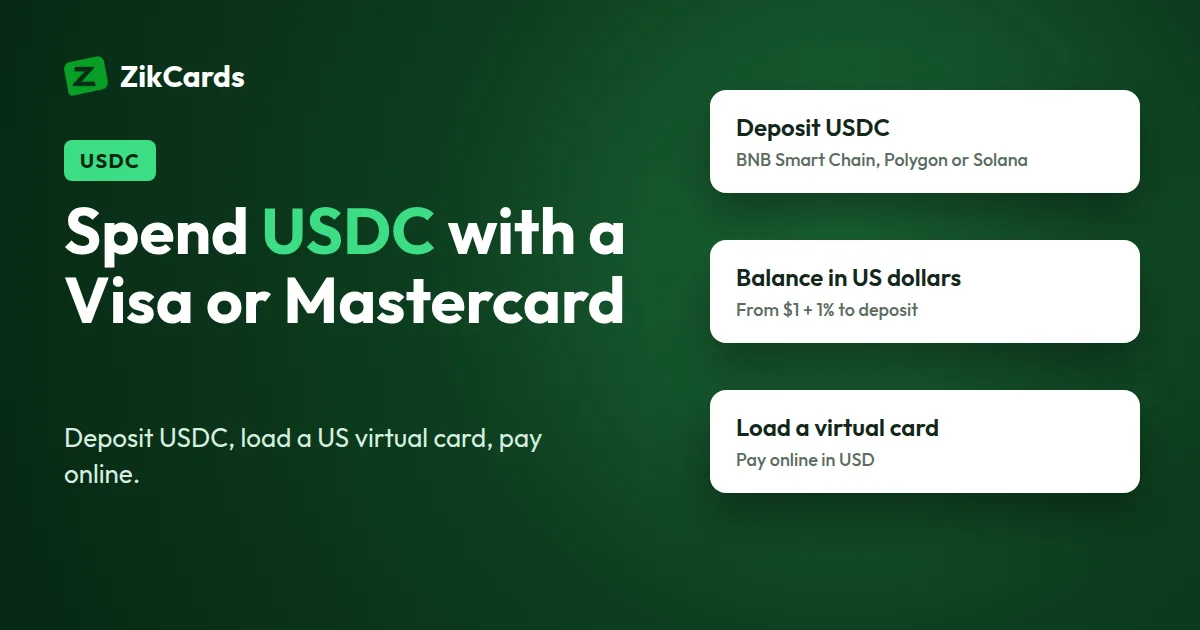
ZikCards issues US Visa and Mastercard virtual cards. You fund your balance with USDC (or USDT), then load a card from that balance. Here is the full path from your wallet to a payment.
- Create your account and verify once. You need a photo ID (passport, national ID card or driving licence) and a short selfie on your phone. Most verifications are approved automatically within minutes. See what ID you need.
- Start a USDC deposit and choose a network. Pick BNB Smart Chain, Polygon or Solana. You get a deposit address for that network.
- Send USDC from your wallet or exchange on the same network. Check the network name on both sides before you press send.
- Wait for the deposit to arrive. Once the network confirms it, the amount is added to your balance in US dollars. See how long a deposit takes.
- Create a card. Choose Visa or Mastercard. The card is ready in seconds. You can give it a name on the My cards page afterwards.
- Load the card. Move the amount you plan to spend from your balance to the card. Remember that $1.20 stays on each open card, so load the price plus $1.20.
- Pay. Reveal the card number, expiry and security code on the card page, and use the card's own billing address at checkout, not your home address. See which billing address to use.
Which networks to use for USDC, and which to avoid
USDC exists on many blockchains. The same token name on two networks does not mean the two are connected. If you send on a network the deposit address was not created for, the money usually cannot be recovered.
| Network | USDC deposits at ZikCards | Notes |
|---|---|---|
| BNB Smart Chain (BEP20) | Yes | Low network fees, widely offered by exchanges |
| Polygon | Yes | Low network fees |
| Solana | Yes | Fast and usually cheap to send |
| Ethereum (ERC20) | No | Not accepted for USDC |
| TRON (TRC20) | No | Not accepted for USDC |
A few habits prevent almost every deposit mistake:
- Match the network, not just the token. In your exchange's withdrawal form, choose the exact network shown on your ZikCards deposit page.
- Copy and paste the address. Never type it by hand. After pasting, check the first and last few characters.
- Send a small test first if this is your first deposit from a new wallet or exchange.
- Allow for the exchange's own withdrawal fee. Some exchanges take their fee from the amount you send. If less arrives than you expected, see why a deposit can arrive short.
USDC vs USDT for funding a card
Both are stablecoins that track the US dollar, and both can fund a ZikCards balance. For spending with a card, the differences are small but worth knowing.
| USDC | USDT | |
|---|---|---|
| Issuer | Circle | Tether |
| Networks at ZikCards | BNB Smart Chain, Polygon, Solana | BNB Smart Chain, Polygon, Solana, TRON, Ethereum |
| Deposit fee | From $1 + 1%, depending on the network (see pricing) | |
| Credited as | US dollars on your balance | |
In practice, use whichever stablecoin you already hold. Converting one to the other on an exchange costs a trading fee and adds a step. If you hold USDT on TRON or Ethereum, those networks are open for USDT only; see which network to send USDT on. ZikCards does not sell USDC or USDT. Buy it on an exchange that is allowed to serve your country, keep the trade on the exchange, and never move a deal to WhatsApp or Telegram. Rules on digital assets change, so check what applies where you live.
What it costs to spend USDC this way
Every fee is on our pricing page. In short:
- Deposit: from $1 + 1%, depending on the network.
- Card creation: $5 one time. There is no monthly card fee.
- Loading a card: 3% of the amount you load.
- Issuer fees: $0.40 for each declined payment, and $0.50 + 2.5% on purchases that settle outside the US.
- Closing a card: free. The remaining balance goes back to your wallet in full.
A simple example: you want to pay a $20 monthly plan. Load at least $21.20 onto the card, because $1.20 stays on the card while it is open. The 3% load fee is charged on top, from your balance. To avoid paying decline fees on failed retries, load enough before the renewal date rather than waiting for a decline.
Is it really a USDC debit card?
Not exactly. People search for a "USDC debit card" because they want a card that spends money they already have. That is how ZikCards works: the card is loaded from your balance first and spends only what is on it. There is no credit line, no monthly bill, no interest and no credit check.
The card number range (the BIN) is registered with Visa and Mastercard as a US credit BIN, so a BIN check shows "credit" and country USA. That is a technical fact about the number, not a loan. To learn more, read prepaid vs credit BIN and what a BIN number is, or check any card with our free BIN lookup.
Where you can use the card, and where you cannot
The card works for online payments wherever Visa or Mastercard is accepted, and a card can be added to Apple Pay or Google Pay for paying in shops; see the wallet guide. Common uses are subscriptions, software, hosting, online courses and online shopping. Read our guides on subscriptions and AI tools.
A US card removes the most common reason cards from many countries are refused, the card's country. But each merchant runs its own checks, so no card provider can promise acceptance. If a payment fails, read why a card is declined online.
Some merchant groups are always blocked, including gambling, crypto purchases and money transfer, cash advances, and stored value cards. So you cannot use the card to buy more crypto. There is no ATM or cash access. See the full list of blocked purchases.
Mistakes to avoid
- Choosing TRON or Ethereum for USDC. These networks are not open for USDC deposits. Use BNB Smart Chain, Polygon or Solana.
- Loading the exact price. Add $1.20, or the payment will fail and a decline fee may apply.
- Using your home address at checkout. Use the billing address shown on the card page.
- Closing a card while a refund is pending. Refunds return to the card that was charged. Keep it open until the refund arrives; see how refunds work.
- Sharing a 3D Secure code. A 3D Secure check may ask for a one-time code. If it does, the code appears on your dashboard and is valid for that one payment. ZikCards never asks for it. See the 3D Secure guide.
Frequently asked questions
Can I spend USDC directly with a Visa card?
Not directly. Card networks settle in normal currencies. With ZikCards, your USDC is credited to your balance in US dollars, and the Visa or Mastercard virtual card is loaded from that balance.
Is ZikCards a USDC debit card?
It is a US virtual Visa or Mastercard that you fund with USDC. The card spends only what you load onto it, with no credit line. Its BIN is registered as a US credit BIN, which is a technical label, not a loan.
How do I convert USDC to Visa?
Deposit USDC on BNB Smart Chain, Polygon or Solana. It arrives on your balance in US dollars. Then create a Visa card and load it from your balance. The deposit fee is from $1 + 1%, and loading a card costs 3%.
Which network should I use to send USDC?
BNB Smart Chain, Polygon or Solana. Choose the same network on your exchange as on your ZikCards deposit page. Never choose TRON or Ethereum for USDC.
What if I sent USDC on the wrong network?
Contact support with the transaction details, but be ready for bad news: wrong-network sends are usually unrecoverable. This is why a small test deposit is worth it.
Can I withdraw back to USDC?
Money on a card can only come back by closing the card, which returns the full balance to your wallet for free. See the pricing page for current withdrawal options and fees.
Do I need a bank account?
No. The balance is funded only with USDC or USDT, so no bank account is involved. Read more in virtual card without a bank account.
Ready to spend your USDC online? Create your ZikCards account. See every fee on our pricing page.
Visa, Mastercard, USDC, Circle, USDT, Tether, Apple Pay and Google Pay are trademarks of their respective owners. ZikCards is not affiliated with or endorsed by them.