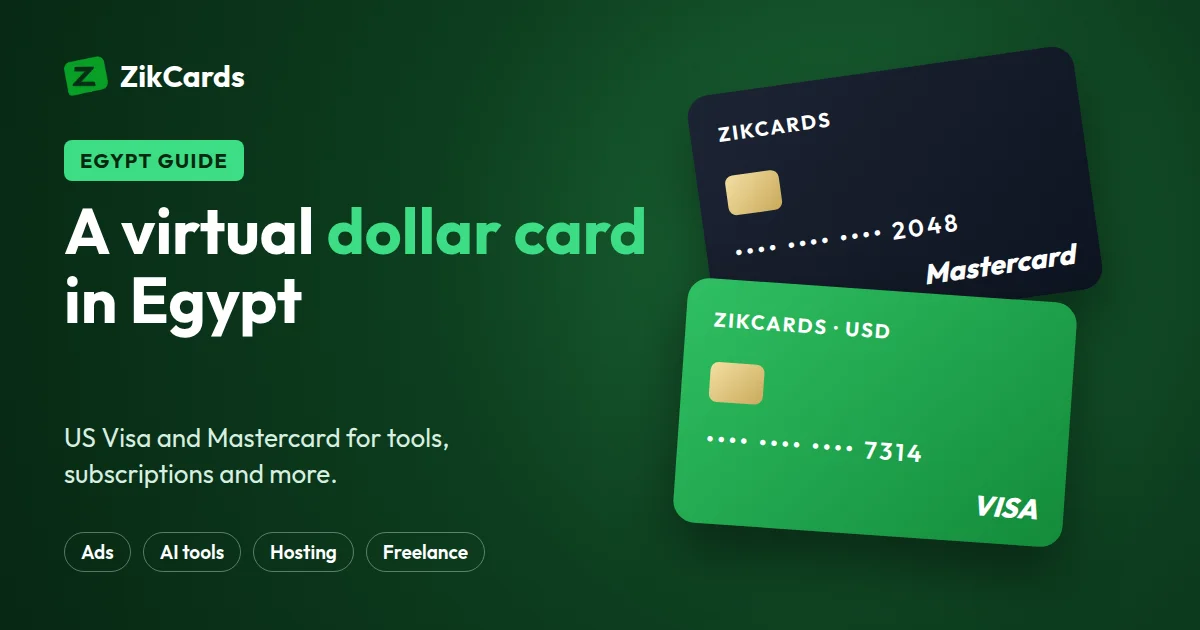
You try to pay for an AI tool, a hosting plan or an ad account, and your Egyptian card is refused, or the payment goes through at a different amount than you expected. Freelancers, sellers and agencies in Egypt meet this often, because most online platforms bill in US dollars and check where a card comes from. This guide explains why some Egyptian cards are refused online, how a US virtual dollar card works from Egypt, how people fund one, and what it really costs.
Why some Egyptian cards are refused online
A refused payment is rarely about one thing. These are the most common reasons a card issued in Egypt fails at a dollar checkout:
- The card's country. Many payment systems at US platforms look partly at the country of the bank that issued it. Cards issued outside the US can be refused more often, and retrying doesn't change the country.
- Conversion from Egyptian pounds. A dollar charge on a card held in pounds is converted at your bank's rate, often with extra bank charges. The amount taken from your account can be more than the price, and you may only see the real figure after the payment.
- Online and international settings. Many cards have online or international payments switched off by default, or need them turned on in the banking app first. If the setting is off, the payment is declined even with money in the account.
- Billing address and verification. Many checkouts run a check that may ask for a one-time code. If the code arrives late, or the billing address you typed doesn't match your bank's records, the payment fails.
For a full list of decline reasons and what to do about each, read why cards are declined online.
How a US virtual dollar card works
A virtual card is a real Visa or Mastercard with a card number, expiry date and security code, but no plastic. You use it online like any other card. If you are new to the idea, our guide on what a virtual card is covers the basics.
When the card is issued in the United States and holds US dollars, the merchant sees a US card charged in its own currency. There is no conversion at checkout, and the card's country is no longer the reason for a decline. Each platform still runs its own checks, so no card provider can promise that a payment will be accepted.
When people search for a virtual dollar card in Egypt, these are the questions worth asking of any provider:
- Where is the card issued? A US card removes the issuing-country problem above. A card issued elsewhere may not.
- Is there a monthly fee? A small monthly fee on every card adds up if you keep one card per client or per tool.
- Does it support 3D Secure? Many merchants run a check that may ask for a one-time code. See how 3D Secure works on a virtual card.
- Can you get your money back? Check how you recover an unused balance, and what it costs.
Virtual Visa card or virtual Mastercard?
For most people in Egypt, either works: both brands are accepted almost everywhere online. If a payment is refused on one brand, a card of the other brand is worth one try before anything else. With ZikCards you choose Visa or Mastercard each time you create a card, so you can keep one of each. Our Visa vs Mastercard guide explains the small differences.
How to get a US virtual card in Egypt with ZikCards
- Sign up and verify once. Create an account at zikcards.com and verify with your passport, national ID card or driving licence and a short selfie on your phone. Most verifications are approved automatically within minutes. You must be 18 or older. See what ID you need.
- Add USDT or USDC to your balance. ZikCards is funded with USDT (on BNB Smart Chain, Polygon, Solana, TRON or Ethereum) or USDC (on BNB Smart Chain, Polygon or Solana). There are no bank, card or Egyptian pound deposits. Always send on the network you chose: which network to use.
- Create a Visa or Mastercard. Choose the brand and load the amount you plan to spend, plus the $1.20 that stays on the card while it is open. The card is ready in seconds. You can give it a name on the My cards page afterwards, for example the client or tool it is for.
- Pay in dollars. Enter the card number, expiry and security code at checkout, with the card's own billing address shown on your card page, not your home address in Egypt. Why the billing address matters.
If the merchant runs a check that asks for a one-time code, the code appears at the top of your ZikCards dashboard, and in Telegram if you have connected it. ZikCards never asks you for this code. See what to do when a merchant asks for a code.
How people in Egypt get USDT or USDC
ZikCards doesn't sell USDT or USDC. Most people get it in one of two ways:
- An exchange that is allowed to serve Egypt. On an exchange's P2P marketplace you pay another user in pounds, and the exchange holds their USDT or USDC in escrow until the seller confirms your payment. Pick sellers with many completed trades and a high completion rate.
- From someone you already work with, such as a client who pays you in USDT or USDC.
Before you buy:
- Check the rules that apply to you. Rules on digital assets change, and what an exchange may offer in Egypt can change with them. Check what applies to you before you buy.
- Keep the whole trade inside the exchange. Pay only the account named in the order, talk only in the exchange's own chat, and never move a trade to WhatsApp or Telegram. Fake payment messages and off-platform deals are the usual P2P scams.
- Withdraw on the same network you will deposit on, and check the exchange's withdrawal fee first. A transfer sent on the wrong network is usually lost: which network to use.
What it costs: a real example
Say you spend $100 a month on ads and tools. These are ZikCards' published fees; every one is on the pricing page.
| Step | Amount |
|---|---|
| Add $111 to your balance (deposit fee from $1 + 1%, depending on the network) | you send from $113.11 in USDT or USDC |
| New card, one-time (first card with a discount code) | $5 ($3 with a code) |
| Load $102 onto the card (3% loading fee) | $105.06 from your balance |
| Kept on the card while it is open, returned when you close it | $1.20 |
| Available to spend on the card | $100.80 |
| Monthly card fee | none |
One fee to plan for. Purchases that settle outside the US carry the card issuer's cross-border fee of $0.50 + 2.5%, taken from the card. Some platforms may bill you through a company outside the US, so keep a little extra on the card for those payments.
On ZikCards, the cost in pounds depends on the price you pay for USDT or USDC, so compare a few sellers before you buy.
What people in Egypt use it for
- Ads for clients and their own businesses, in ad accounts billed in dollars. A separate card per ad account or per client keeps budgets apart and makes every invoice easy to match.
- AI tools and software. Chat assistants, design and video tools, and coding tools. Our guide to paying for AI tools covers this in detail.
- Subscriptions. Monthly plans on a card that only holds what the plan costs, so a forgotten trial can't take more.
- Hosting and domains. Monthly and yearly renewals for websites and online stores.
- Freelance platform fees. Membership plans and bids on platforms that bill in dollars.
Check the service is available in Egypt. A card changes how you pay, not where a service operates. If a platform doesn't offer its service in Egypt, a different card won't change its rules, and each platform runs its own checks on every payment.
Tips that save money and trouble
- Keep the card funded before renewals. The card issuer charges $0.40 for every declined payment, taken from the card, retries included.
- Stop after two or three declines. Repeated failures look like fraud to payment systems. Find the reason first, then try again.
- Close cards you no longer need. Closing is free, stops all charges and returns the balance to your wallet, including the $1.20. Keep a card open until any expected refund has arrived. Freeze or close?
- Check a card before you use it. Our free BIN lookup shows what a merchant sees about a card's issuer and country. Our guide on what a BIN number is explains more.
Frequently asked questions
Is it a virtual credit card or a virtual debit card?
It is issued on a US credit BIN: that is how the card range is registered with Visa and Mastercard, and what a BIN check shows. But no credit is given: you load the card first and can only spend what is on it. There is no bill, no interest and no credit check.
Can I get a virtual Visa card in Egypt?
Yes. When you create a card you choose Visa or Mastercard. Both are issued in the US and hold US dollars, and you can keep one of each.
Can I pay for ads from Egypt with it?
A US card removes the most common reason Egyptian cards are refused, the card's country, but every ad platform runs its own checks, so no card provider can promise that a platform will accept a payment. See using ZikCards for ads.
Can I fund it with Egyptian pounds or a bank account in Egypt?
No. ZikCards balances are funded with USDT or USDC only.
Can I add it to Apple Pay or Google Pay?
A card can be added to Apple Pay or Google Pay by hand, with the card details and the card's own billing address. See how to add a virtual card to Apple Pay or Google Pay.
Can I receive payments on it?
No. It is a card for paying online, not an account for receiving payouts from clients or freelance platforms.
Is Egypt supported?
Yes. Egypt is not on our restricted countries list, so you can sign up and verify with a passport, national ID card or driving licence. See is ZikCards available in my country.
Paying for dollar services from Egypt? Create your ZikCards account. See every fee on our pricing page.
Visa, Mastercard, Apple Pay, Google Pay, WhatsApp and Telegram are trademarks of their respective owners. ZikCards is not affiliated with or endorsed by them.