You set up a campaign in TikTok Ads Manager, add a card, and see "Payment failed" or "Your card was declined". Or your ads stopped because a charge did not go through. This guide explains automatic and manual payment, how to add a card, how billing thresholds work, why the currency and time zone matter, why payments fail and how to fix them, and how to pay with a virtual card.
How TikTok charges for ads
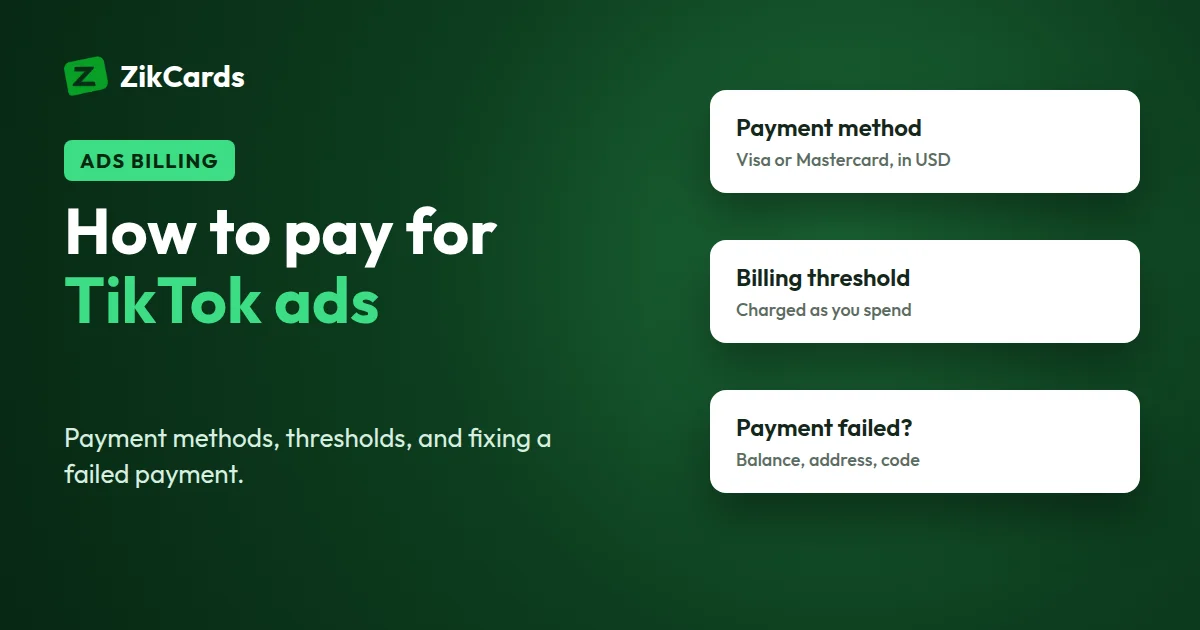
TikTok ads are paid through an ad account in TikTok Ads Manager. Depending on your country, currency and account, TikTok usually offers one of two ways of paying. You often choose this when you first set up billing, and it may be hard to switch later.
- Automatic payment. You add a payment method, the ads run, and TikTok charges you after the spending happens. A charge is usually taken when your spend reaches your billing threshold, or at the end of a billing period, whichever comes first. New accounts may start with a low threshold, which may rise over time as payments succeed. TikTok sets the threshold, and the rules can change.
- Manual payment. You add money to the ad account first, and the ads spend from that balance. When the balance runs out, the ads stop until you add more. In some countries this is the only option, and in others it is offered next to automatic payment.
With automatic payment, the threshold matters more than your daily budget. A $30 daily budget and a $150 threshold could mean one charge of about $150 every five days or so, not $30 a day. In some countries tax is added to the charge, so the amount taken can be higher than the threshold. Your card has to cover the whole charge at once.
Our free TikTok ads budget calculator helps you plan daily and monthly spend, and the break-even ROAS calculator shows how much return your ads need before they make money.
Which payment methods you can use
The methods you see depend on your country, the ad account's currency and the payment type you chose. In general, TikTok may offer:
- Cards on networks such as Visa and Mastercard, the most common method for automatic payment.
- PayPal, in some countries.
- Local methods in some countries, usually with manual payment only.
Where to add a card in TikTok Ads Manager
- In TikTok Ads Manager, open the payment section, usually under Tools or your account menu. Menu names change from time to time.
- Check that you are in the right ad account, especially if you manage several in a Business Center.
- Choose to add a payment method, select card, and enter the card number, expiry date, security code and cardholder name.
- If the form asks for a billing address, enter the billing address that belongs to the card, exactly as the card's issuer has it.
- With manual payment, enter the amount you want to add and confirm the payment.
When you add a card, TikTok may place a small temporary authorisation on it to check that it works. It is not a charge, but the card usually needs money available for the check to pass. The card's issuer may also run a 3D Secure check that may ask for a one-time code. Our 3D Secure guide explains how that works.
Currency and time zone: set when the account is created
When you create a TikTok ad account, you choose its country, currency and time zone. In most cases these cannot be changed later as a simple edit, at the time of writing. Check TikTok's help pages before you choose, and pick the currency you plan to pay in.
If the account is in US dollars and your card holds US dollars, charges need no conversion. In another currency, the card network converts every charge at its own rate. Daily budgets follow the account's time zone, and the country may decide which payment methods you see and whether tax is added.
Why TikTok ads payments fail
- International or online payments are switched off. Many bank cards need them turned on in the banking app.
- The card's country. Cards issued in some countries are refused more often by online platforms, even with money on them.
- Billing address mismatch. The address you typed does not match the one the card's issuer holds.
- Not enough for the threshold charge. The card had enough for a day of ads but not for the full threshold charge, plus any tax and fees.
- The temporary authorisation failed. The card was empty or nearly empty when you added it.
- Too many retries or card changes. Several failed attempts, or adding and removing cards again and again, can lead TikTok to restrict the account's payments.
For decline messages in general, read why cards are declined online.
How to fix a failed TikTok ads payment
- Find the reason first. Read the message in the payment section of Ads Manager, and check your bank or card app for a declined attempt and its reason.
- Fix the cause. Add money to the card, switch on online and international payments, or correct the billing address.
- Pay the outstanding balance. Use the option in the payment section to pay what you owe. Your ads usually stay paused until it is paid.
- Retry once. If it fails again, stop and look for the cause again rather than pressing pay repeatedly.
- If the account is restricted or suspended, follow TikTok's own process. Ads Manager usually shows the reason and, where TikTok allows it, a way to appeal. A new card does not change TikTok's decision about a restricted account.
Virtual card for TikTok ads: how it works
A virtual card is a Visa or Mastercard with a number, expiry date and security code, but no plastic. It keeps ad spend apart from your main bank account. See what is a virtual card and Visa vs Mastercard.
A US card removes the most common reason cards from some countries are refused, the card's country, but TikTok runs its own checks, so no card provider can promise acceptance. These habits keep payments running:
- One card per ad account or per client. One client's spend never touches another's, and every receipt matches one card.
- Keep the balance above the next threshold charge. On a ZikCards card, $1.20 stays on the card while it is open, so what you can spend is the balance less $1.20.
- Use the card's own billing address, shown on the card page, not your home address: why the billing address matters.
- Allow for the cross-border fee. Depending on where your business is, TikTok may bill you through one of its companies outside the US. Purchases that settle outside the US carry the card issuer's cross-border fee of $0.50 + 2.5%, taken from the card.
- Avoid declines. The issuer charges $0.40 for every declined payment, taken from the card, and TikTok may retry a failed charge.
Here is how much to keep on a card for a $150 threshold charge billed from outside the US:
| Item | Amount |
|---|---|
| Threshold charge | $150.00 |
| Cross-border fee ($0.50 + 2.5% of $150) | $4.25 |
| Stays on the card while it is open | $1.20 |
| Minimum balance on the card | $155.45 |
| Sensible load, with a margin for tax or a slightly larger charge | about $165 |
If TikTok bills you from the US, leave out the cross-border fee, so the minimum is $151.20. With manual payment, use the amount you add instead. Loading a card has its own fee, listed on the pricing page.
How to set it up with ZikCards
- Sign up and verify once. Create an account at zikcards.com and verify with a photo ID (passport, national ID card or driving licence) and a short selfie on your phone. Most verifications are approved automatically within minutes. See what ID you need.
- Add money to your balance with USDT or USDC stablecoins. There are no bank or card deposits, and the deposit fee is from $1 + 1%, depending on the network. Always send on the network you chose: which network to use.
- Create a card for the ad account. Choose Visa or Mastercard and load the next threshold charge plus the $1.20 and a margin. The card is ready in seconds. Name it after the client or ad account on the My cards page.
- Add it in TikTok Ads Manager with the card number, expiry, security code and the card's own billing address. If a check asks for a one-time code, it appears at the top of your ZikCards dashboard: where to find the code.
- Top up before the next charge. If you stop advertising, pause the ads in TikTok before you freeze the card, because each declined charge on a frozen card still costs $0.40: freeze or close.
A card changes how you pay, not where TikTok offers advertising. Follow TikTok's advertising policies.
Frequently asked questions
Why does TikTok say my payment failed when there is money on my card?
Common reasons are that the card had enough for the ads but not for the full threshold charge, online or international payments are off, or the billing address does not match. The card's country can also be the reason. On a ZikCards card, $1.20 stays on the card while it is open, so you can spend the balance less $1.20. Check each reason, then retry once.
When does TikTok charge for ads?
With automatic payment, usually at your billing threshold or the end of a billing period. With manual payment, you add funds first.
Can I change the currency or time zone of my TikTok ad account?
Usually not as a simple edit, because both are set when the ad account is created. Check TikTok's help pages for what applies to your account, and choose carefully at the start.
What happens if a TikTok ads payment fails?
Your ads usually stop until the outstanding balance is paid. Fix the cause, pay the balance in the payment section of Ads Manager, and retry once. Repeated failures may lead to a payment restriction, which you handle through TikTok's own appeal process.
Can I use a virtual card for TikTok ads?
You add it in TikTok Ads Manager like any other card. A US card removes the most common reason cards from some countries are refused, the card's country, but TikTok runs its own checks, so no card provider can promise acceptance.
Does the card give me credit for ad spend?
No. A ZikCards card is issued on a US credit BIN, but no credit is given. It is loaded from your balance first and spends only what is on it, with no bill and no interest.
Ready to give your TikTok ad budget its own card? Create your ZikCards account. See every fee on our pricing page.
Visa, Mastercard, TikTok and PayPal are trademarks of their respective owners. ZikCards is not affiliated with or endorsed by them.