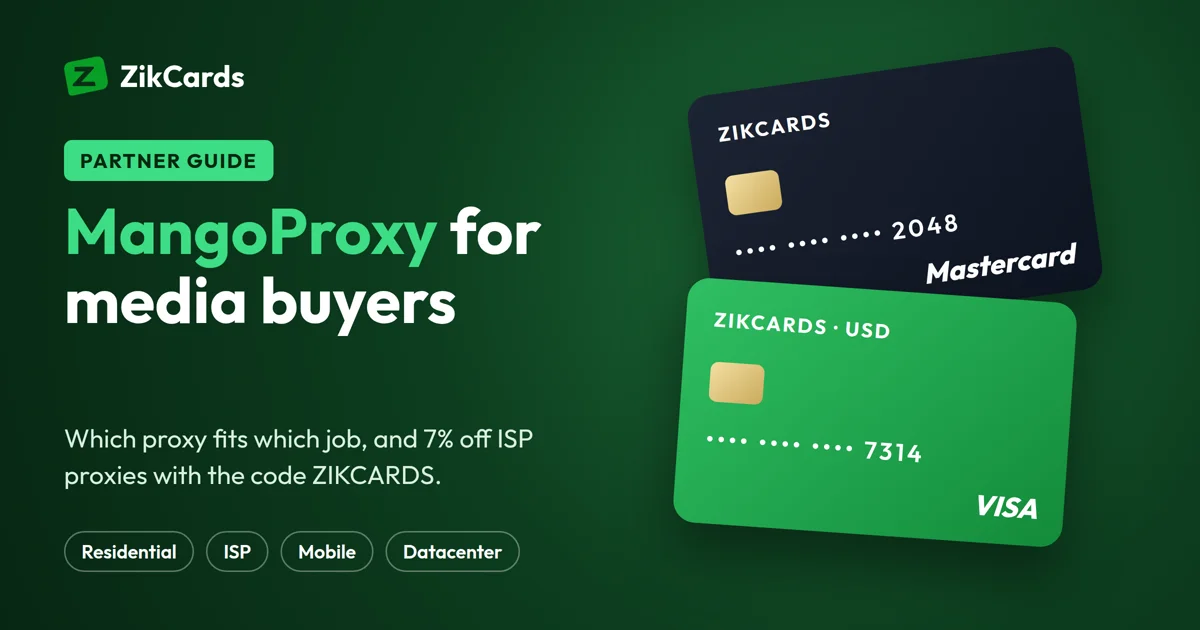
If you run ads for several clients, test campaigns in other countries, or check how your ads look from abroad, you will need proxies sooner or later. MangoProxy, a ZikCards partner, offers residential, ISP, datacenter and mobile proxies across 200+ countries. This guide explains which of their proxy types fits which media-buying job, what to check before you buy, how to get 7% off ISP proxies with the code ZIKCARDS, and how to pay for proxies and ad accounts with separate virtual cards.
What MangoProxy is
MangoProxy is a proxy provider for web scraping, automation and multi-account management. It sells both kinds of proxy that media buyers use: rotating proxies billed per gigabyte of traffic, and static proxies billed per address, which keep the same IP for as long as you need it.
- Coverage: 200+ countries, with large pools in markets such as the USA, Brazil, Germany, Italy, India and Turkey.
- Protocols: HTTP(S) and SOCKS5, so the proxies work with browser profiles, ad tools and scripts.
- Rotation: instant, sticky or timed rotation on dynamic proxies; a fixed IP on static ones.
- Payment: cryptocurrency and cards.
- Free tools: a proxy checker, IP lookup and DNS leak test on their site, useful for checking a setup before you log in anywhere.
Visit MangoProxy and use the code ZIKCARDS for 7% off ISP proxies.
Why media buyers use proxies
Most media buyers do not use proxies to hide anything. They use them because their work happens in many places at once:
- Checking ads in other countries. To see what a campaign looks like in Brazil or Germany, including the landing page and the price shown, you need to browse from there.
- Keeping clients apart. An agency that manages ad accounts for several businesses keeps each one in its own browser profile with its own address, so a problem with one never touches the others.
- Ad verification and research. Looking at competitors' ads, placements and offers in a target market.
- Automation and data collection. Tools that collect public prices, rankings or ad libraries work more reliably with a pool of addresses.
Every ad platform has its own rules about accounts, access and automation. Read them before you set anything up: a proxy is a tool for legitimate work, not a way around a platform's policies.
Which MangoProxy product fits which job
| MangoProxy product | How it works | Best for |
|---|---|---|
| Residential proxies | Home internet addresses, billed per GB, rotating or sticky | Checking ads and landing pages as a local visitor; research in many countries |
| Static ISP proxies | A fixed address registered to an internet provider, billed per IP | One stable address per client or ad account, kept for weeks |
| Mobile and dedicated mobile proxies | Addresses from mobile carriers | Work where mobile traffic is normal, such as social and app platforms |
| Datacenter proxies | Cloud server addresses, the cheapest per GB or per IP | Fast automation and data collection where a local look is not needed |
For long-running work such as managing an ad account, a stable address is usually better than one that changes on every request, which is why static ISP proxies are the usual choice for account work, and why the ZIKCARDS code applies to them. Rotating residential proxies suit research and checking, not logging in to the same account every day.
What it costs
At the time of writing (October 2026), MangoProxy lists residential proxies from $2 per GB, datacenter proxies from $0.60 per GB and static ISP proxies from $2.49 per IP. Prices depend on the volume and the country, and they change, so check the current prices on MangoProxy's site. The code ZIKCARDS takes 7% off ISP proxies.
To estimate a monthly budget: count one static ISP address per ad account or client you manage, then add residential traffic for checking ads abroad. Checking pages uses far less traffic than scraping, so a small residential package often lasts a long time.
What to check before you buy
- Locations: the countries, and ideally the cities, your campaigns target.
- Sticky sessions: for logged-in work, a static IP or a long sticky session, never instant rotation.
- Protocols: HTTP(S) or SOCKS5, whichever your browser profiles and tools use.
- Your traffic: per-GB plans for checking and research, per-IP plans for account work.
- Start small: buy one or two addresses first and test speed and stability before scaling up.
One card per ad account
The same idea that makes a separate proxy per client useful applies to payments. When every ad account and every tool shares one card, a single failed payment or a blocked card stops everything at once, and your statement mixes all clients together.
- Give each ad account its own virtual card, named after the client, so costs are separate and a problem with one card touches nothing else: virtual cards for ad accounts.
- Use the card's own billing address at checkout, exactly as shown on the card page: which billing address to use.
- Keep the card dashboard open when you add a card to a platform, in case a 3D Secure check asks for a one-time code: how 3D Secure works.
- Keep a margin on each card for billing thresholds and tax.
No card provider can promise that every platform will accept a payment; each platform runs its own checks. A US-issued card in dollars removes one common reason payments from many countries are refused, the card's country.
Paying for MangoProxy with a virtual card
MangoProxy takes cards and crypto. Paying with a card you keep only for proxies and tools keeps those charges apart from your ad spend and your personal account, and makes renewals easy to track. With ZikCards you fund one balance with USDT or USDC (deposits cost from $1 + 1%, depending on the network) and load each card from it. A card costs $5 to create, loading money onto a card costs 3%, and there is no monthly card fee. $1.20 stays on each card while it is open, so load a little more than the order: for a $30 proxy order, about $32 covers it. Each card is a US-issued Visa or Mastercard on a US credit BIN, loaded from your balance, with no credit line. Every fee is on our pricing page. If a payment is ever refused, see why cards are declined online.
Common mistakes
- Using rotating addresses for logged-in work. An account that sees a new country every few minutes looks unusual. Use a static ISP proxy for each account.
- Billing details that do not match the card. A payment form filled in with a different address from the card's own is a common reason for a decline. Always enter the billing address shown on the card page.
- Buying the cheapest datacenter proxies for everything. They are great for data collection and a poor fit for platforms that expect home or mobile users.
- Sharing one card across clients. One problem then blocks every account at once.
Frequently asked questions
What is the MangoProxy discount code for ZikCards users?
The code ZIKCARDS gives 7% off ISP proxies at MangoProxy. Offers are set by MangoProxy and can change, so check the terms at checkout.
Which MangoProxy proxy is best for managing ad accounts?
Static ISP proxies: each one keeps a fixed address registered to an internet provider, so an account sees the same location every day. Residential proxies suit research and checking ads in other countries.
Does MangoProxy support SOCKS5?
Yes. MangoProxy supports HTTP(S) and SOCKS5, so its proxies work with most browser profiles and automation tools.
Can I pay for MangoProxy with a virtual card?
Yes. MangoProxy accepts cards and cryptocurrency. A separate virtual card for proxies and tools keeps renewals easy to track and apart from your ad spend.
Are proxies allowed on ad platforms?
Proxies themselves are common networking tools, but each platform sets its own rules about accounts, access and automation. Read and follow the rules of every platform you use.
Running ads for several clients? Create your ZikCards account and give each ad account its own card. See every fee on our pricing page. More services we work with are on our partners page.
MangoProxy, Visa and Mastercard are trademarks of their respective owners. MangoProxy's prices and the ZIKCARDS offer are set by MangoProxy.